| a. |
What
do you understand about resistance? State the factors that determine the
resistance of a conductor at a given temperature. Derive expressions for
the equivalent resistance of three resistors connected
i)
in parallel |
5
marks |
|
|
|
|
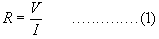
Resistance of a device indicates the ability
of the device to control the current flow in a circuit. It is defined for
a device as |
|
|
 |
|
|
where V and I are the voltage
across and current passing through the device. |
1 |
|
Factors determining
the resistance |
|
|
-
Physical dimension. The longer is the length, the higher is the resistance.
The narrower is the cross-section, the higher is the resistance.
-
Material. Silver is best in conducting. Water is poor conductor. Plastic
is insulator.
-
Temperature (not required in this question). Resistance of metal increases
with temperature. Resistance of semi-conductor decreases as temperature
increases.
|
2 |
|
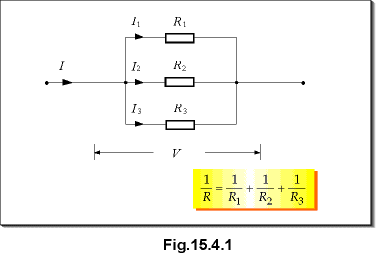
Resistors in parallel |
|
|
 |
|
|
The potential difference is the same across
each resistor. The current through the combination is the sum of the current
through each resistor. |
|
|
 |
|
|
Thus, the equivalent resistance R is
given by |
|
|
 |
1 |
|
|
|
|
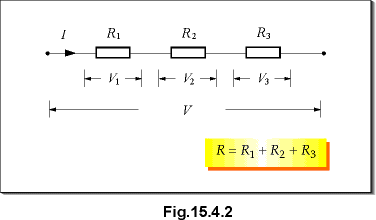
ii)
in series. |
|
|
|
|
|
 |
|
|
The current through all the resistors is the
same. The p.d. across the combination is the sum of the p.d. across each
resistor. Thus, |
|
|
 |
|
|
Thus, the equivalent resistance R is |
|
|
 |
|
|
|
|
| b. |
Describe
and explain how resistance varies with temperature for
i)
a semi-conductor |
4
marks |
|
|
|
|
The resistance of a semi-conductor decreases as temperature
increases.
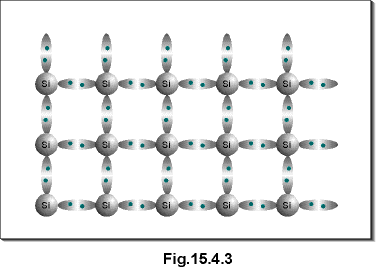
In a semi-conductor, each outer shell electron is paired with an electron
from an adjacent atom forming a rather loosely bound covalent bond. An
increase in termperature increases the thermal agitation and set more electrons
and holes free in the crystal lattice. Thus, resistance decreases. |
2 |
|
 |
1 |
|
|
|
|
ii)
a metal. |
|
|
|
|
|
Resistance of a metal increases with temperature. Metal
conducts electricity by means of free electrons. As temperature increases,
the interaction (collision) of the free electrons with the metal atoms
increases. This increase the resistance. |
1 |
|
|
|
| c. |
The
diagram below illustrates two ways in which the resistance of a resistor
could be measured using a moving-coil voltmeter and a moving-coil ammeter.
Explain why, in each case, the value for the resistance R would not be
correct. State and explain which circuit is better for measuring small
resistance.
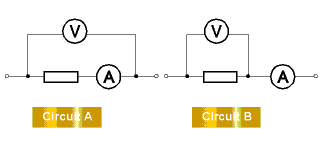 |
5
marks |
|
|
|
|
In circuit A, the voltmeter reading is not correct (too
high) because it is the sum of the p.d. across the resistor and the p.d.
across the ammeter. |
1 |
|
In circuit B, the ammeter reading is not correct
(too high) because it is the sum of the current through the voltmeter and
the resistor. |
1 |
|
Circuit B is better for measuring small resistance. |
1 |
|
When R is small, the current through the voltmeter
(which has a high resistance) becomes negligible. |
2 |
|
|
|
| d. |
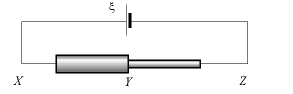
The
diagram below shows two tungsten wires of the same length but different
cross-sectional areas joined end-to-end across the terminals of a voltage
supply of e.m.f. x. Sketch, using the same axes, to show how the electric
field and the potential vary along XYZ. Briefly explain the shape of your
graphs.
 |
2
marks |
|
|
|
|
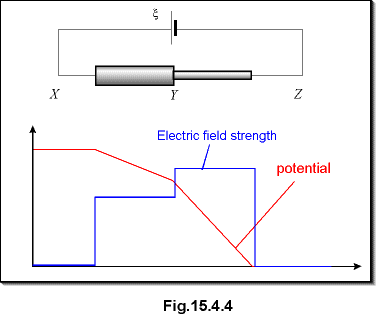
The resistance of XY is less than YZ. Thus, the p.d. across
XY is less than YZ. Since V = E r, the electric field is directly
proportional the the p.d. (length is the same). Thus, E is less for XY
than YZ. |
|
|
 |
|
|
|
|