| a. |
Explain
how a galvanometer can be adapted to measure
i)
larger current. |
6
marks |
|
|
|
|
 |
1 |
|
A galvanometer can be adapted to measure large
current by connecting a small resistance (shunt) in parallel. |
|
|
When a large current flows through the combination,
only a small fraction flows through the galvanometer causing deflection. |
1 |
|
|
|
|
ii)
voltage |
|
|
|
|
|
 |
1 |
|
A galvanometer can be adapted to measure voltage
by connecting a large resistance (multiplier) in series. |
|
|
When a large voltage is applied across the
combination, only a small fraction is applied across the galvanometer. |
1 |
|
|
|
|
iii)
resistance. |
|
|
|
|
|
 |
1 |
|
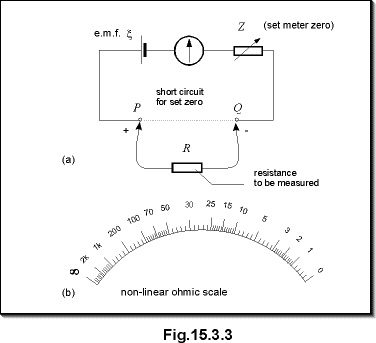
Before the circuit in (a) is used to measure
resistance, the input terminals P and Q are shorted. Then
Z is adjusted to give full scale deflection. |
|
|
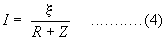
When an unknown resistor R is connected across PQ,
the current decreases. The deflection depends on the resistance R. |
|
|
 |
1 |
|
|
|
| b. |
Sketch
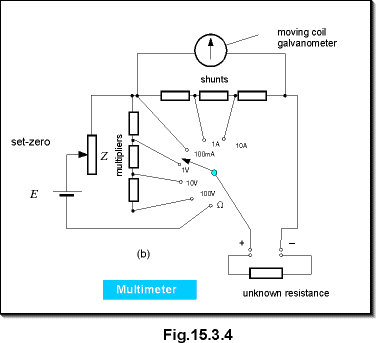
a diagram to show the principle of a multimeter. |
4
marks |
|
|
|
|
 |
|
|
|
|
| c. |
With
the aid of a diagram, explain how a potentiometer can be used to
i)
measure the internal resistance of a cell |
6
marks |
|
|
|
|
 |
1 |
|
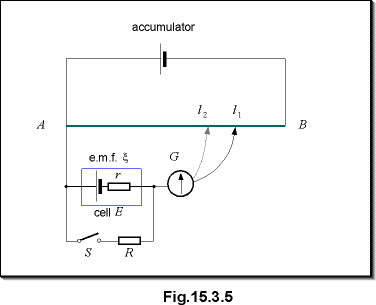
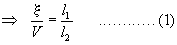
With S open, the potentiometer measures the
e.m.f. x. Suppose the balance length is l1. |
|
|
With S closed, the potentiometer measures the terminal
voltage, V. Suppose the balance length is l2. |
|
|
 |
1 |
|
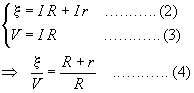
Let r be the internal resistance and
R be the known resistor. |
|
|
 |
|
|
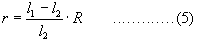
From (1) and (4), we have |
|
|
 |
1 |
|
|
|
|
ii)
calibrate a voltmeter. |
|
|
|
|
|
 |
2 |
|
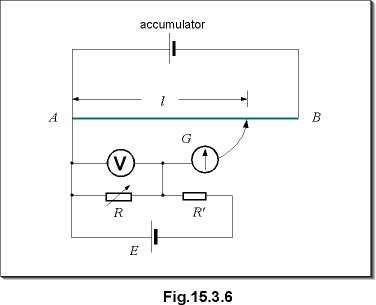
By varying R, the voltage across the
voltmeter is changed. This voltage is correctly indicated by the potentiometer.
Thus, the voltmeter can be calibrated. |
1 |
|
|
|