Chapter 15 Question 2
 
a. State the difference between electromotive force (e.m.f.) and potential difference. 2 marks
 
The e.m.f. of a source is defined as the energy transferred into electrical p.e. per unit charge within the source. 1
The p.d. between two points in a circuit is the amount of electrical energy changed into other forms of energy per unit charge passing between the points. 1
(N.B. e.m.f. is used to describe power supply while p.d. is used to describe electric devices.)
 
b. State three primary sources of e.m.f. and give an example of application in each case. 3 marks
 
Primary source Principle Example
Light Photoelectric effect Solar cell
Chemical energy Chemical reaction between electrodes and electrolyte Car battery
Heat Seebeck effect Thermocouple
Pressure Piezoelectric effect Quartz crystal
Kinetic energy Electromagnetic induction A.C. generator
 
Any 3
 
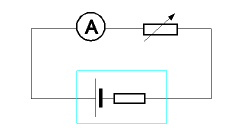
c. The circuit below can be used to determine the internal resistance of a cell. Describe how you would perform the experiment using the given apparatus in order to work out the internal resistance of the cell.

 c15.0.1.gif (1967 bytes)

6 marks 
 
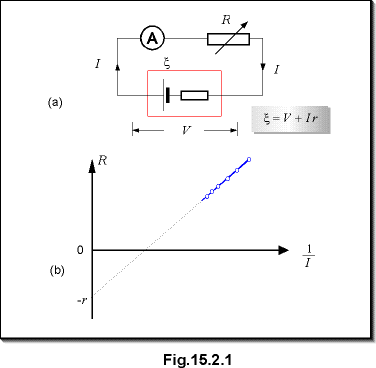
c15.2.1.gif (5730 bytes) 2
Let the e.m.f. and internal resistance of the cell be x and r respectively.
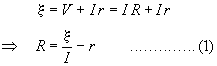
When the resistance is R
2
Perform the experiment by varying the value of R and record the current I every time.
A graph of R is then plotted against 1/I. The slope of the graph give the e.m.f. of the cell and the y-intercept gives the internal resistance. 2
 
d. State the advantages of connecting identical cells in parallel. Discuss the conditions for getting the maximum power output and the largest current from the cell combination. 5 marks
 
Advantages of parallel arrangement of cells:
  1. It can supply a larger limiting current
  2. It lasts longer
  3. It has a smaller internal resistance
2
Getting maximum power output
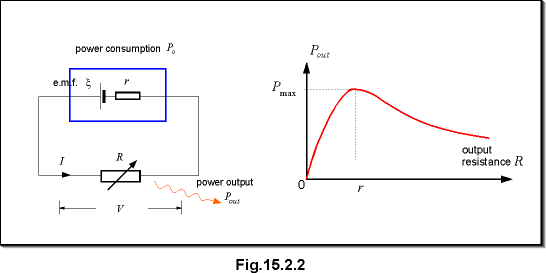
c15.2.2.gif (5603 bytes) 1
The power output of the above circuit is
 
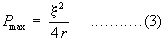
It is the maximum when R = r. 1
The maximum power is 
 
Getting maximum current
Maximum current is obtained by shorting out the terminals of a cell. i.e. R = 0. 1
 
Hosted by www.Geocities.ws

1