| a. |
An
electric circuit consists of a resistor connected across the terminals
of a cell. Describe the process of electrical conduction in the resistor.
Explain why the electric field strength is not the same throughout the
circuit. |
4
marks |
|
|
|
|
A p.d. exists across the resistor. This establishes
an electric field. Under the electric field, electrons are acted on by
an electric force. . |
1 |
|
While electrons are caused to move, they would
collide with the molecules (crystal lattice) in the resistor. As a result,
they move at a constant speed as if the electric force is balanced by a
retarding force. |
1 |
|
The retarding force in the resistor accounts
for the conversion of electrical p.e. into internal energy. |
1 |
|
Thus, in the non-resistive section of the circuit,
as there is no energy dissipation, the retarding force is zero and the
electric field must also be zero so that the electrons would move at constant
speed. |
1 |
| |
|
|
| b. |
Derive
an expression for the current through a conductor in terms of the speed
of the charge-carriers. |
4
marks |
|
|
|
|
 |
|
|
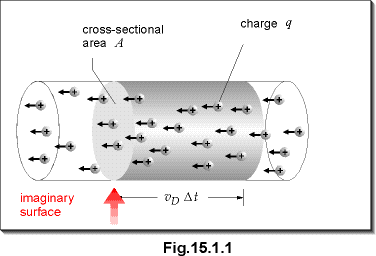
Suppose the average speed of the charge-carrier
is vD. |
|
|
In time Dt, all
the charge-carriers in the shaded region would pass through the imaginary
cross-section. Thus, the number of charge-carriers passing through the
cross section is |
|
|
 |
|
|
where A is the cross-sectional area
of the conductor and n is the number of charge-carriers per unit
volume. |
|
|
Therefore, in time Dt,
the amount of charge flowing is |
|
|
 |
|
|
where q is the charge on each charge-carrier. |
|
|
This contributes to a current I given by |
|
|
 |
|
|
|
|
| c. |
Explain
why the charge-carriers in a metal wire move at a speed different from
those in a semi-conducting wire, both wires having the same physical dimension
and carrying the same current. State and explain whether the electric field
in the two wires are equal or not. |
3
marks |
|
|
|
|
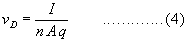
The drift velocity is inversely proportional to the charge-carrier
density: |
|
|
 |
|
|
Since the charge-carrier density in metal is much higher
than that in semi-conductor (nmetal > nsemiconductor),
the drift velocity in metal is much lower. |
1 |
|
Electric field depends on the p.d., V =
E d. |
|
|
The resistance of metal is much lower than semi-conductor.
Under the same current, the p.d. across the metal wire is smaller. |
1 |
|
Thus, the electric field in the metal wire is smaller. |
1 |
|
|
|
| d. |
Give
a brief account on the differences between the speed of electrical signals
and the speed of the charge-carriers. Explain how energy is transmitted
from the power source to the transducers in an electric circuit. |
3
marks |
|
|
|
|
Electrical signal transmits at the same rate as the establishment
of an electric field throughout the circuit. It is close to the speed of
light. |
1 |
|
The drift speeds of charge-carriers are much
slower and depends on the physical dimension of the conductor. |
1 |
|
As an electric field is established around the circuit,
all the charge-carriers are caused to move in the same direction. When
they pass through the cell, they gain electric p.e. As they pass through
the transducer, they do work against the resistance. Electric p.e. is then
converted into other form. |
1 |
|
|
|
| e. |
Briefly
describe an experiment to demonstrate that there are two types of charge-carriers
in an electrolyte. |
2
marks |
|
|
|
|
 |
1 |
|
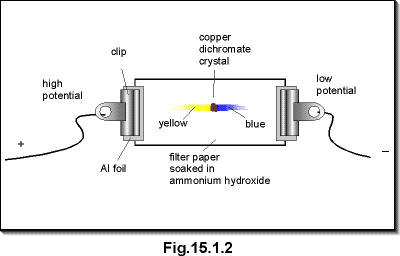
A small brown crystal of copper dichromate is placed at
the center of a filter paper soaked with ammonium hydroxide. A high voltage
is applied across the end of the filter paper. As the crystal dissolves,
it separates into two components, which drifts in different direction.
The blue copper ions drift towards the cathode and are shown to carry +ve
charge. The yellow chromate ions drift towards the anode and are shown
to carry -ve charge. |
1 |
|
|
|
|
|
|
|
|
|