Explain
why the voltage of a charged capacitor cannot be measured accurately by
a moving coil voltmeter. Discuss how you would make correction to this.
4
marks
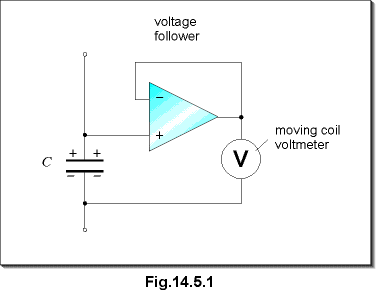
When a moving coil voltmeter is connected across
a charged capacitor, the capacitor discharges through the voltmeter, which
has a finite resistance and needed a current to drive the pointer. (Thus,
there is an initial large deflection and then the deflection falls gradually.)
2
This is corrected by connecting the voltmeter
to the capacitor via a voltage follower which has a very high resistance.
Only negligible current is drawn from the capacitor.
1
1
b.
Explain
the function of a reed switch. Discuss how the capacitance of a capacitor
could be measured using a reed switch.
6
marks
Reed switch
2
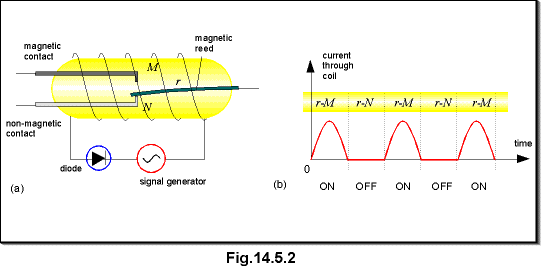
A reed switch consists of two contact, one
magnetic and the other non-magnetic, and a magnetic reed. When current
flows the reed and the magnetic contact are magnetized and attract. When
there is no current, the reed flips to the other contact.
1
The frequency of the ON-OFF cycle is determined
by the frequency of the signal generator.
Measuring capacitance with a reed
switch
1
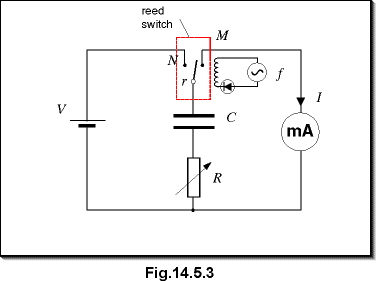
In this experiment, the protecting resistance
R is adjusted until a further decrease in R would not affect
the discharging current I. When this happens, the capacitor is fully
charged and fully discharged in each cycle.
1
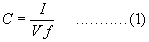
The capacitance is given by
where f is the frequency of the reed
switch and V is the voltage of the supply.
1
c.
The
charging and discharging process of a capacitor could be investigated using
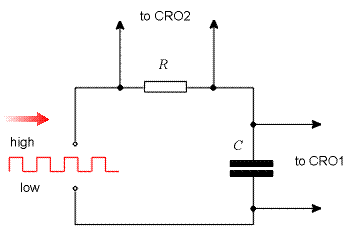
a square wave as shown in the diagram.
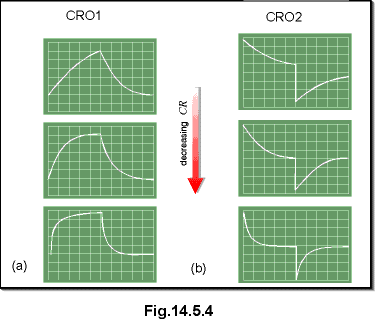
Sketch the result
of the CRO displays for three different values of time constant.