| a. |
The
capacitor shown in the diagram is initially uncharged.
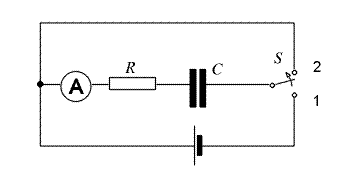
Draw graphs to show
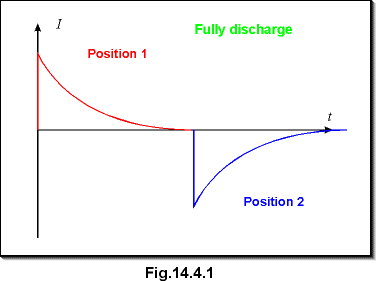
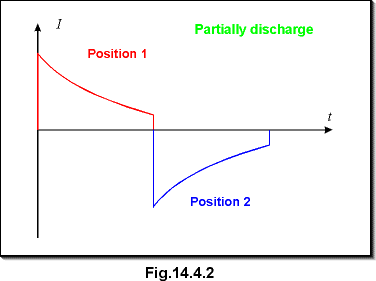
the current through the ammeter as the switch S is switched to position
1 and then, after a while, switched to position 2. You should consider
the following two cases separately
i)
the capacitor is fully charged, |
4
marks |
|
|
|
|
 |
|
|
|
|
|
ii)
the capacitor is not fully charged. |
|
|
|
|
|
 |
|
|
|
|
| b. |
Give
a detailed account on “time constant” when a capacitor is
i)
being charged |
6
marks |
|
|
|
|
 |
|
|
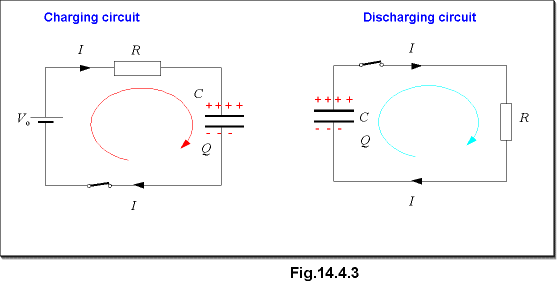
The time constant of the above circuits is
the product of capacitance C and the resistance R. i.e.
time constant = CR. |
|
|
Consider the charging circuit. Suppose the
capacitor is uncharged at t = 0. If Qo is the
charge on the capacitor after a long while, the charge at any time t
is |
|
|
 |
|
|
In particular, when t = CR, the
charge stored is |
|
|
 |
|
|
Thus, the time constant for a charging circuit
is the time required for the charge to reach 0.632 times of the full charge. |
|
|
|
|
|
ii)
being discharged.
Your answer should
include some numerical data. |
|
|
|
|
|
Consider the discharging circuit. Suppose the charge on
the capacitor at t = 0 is Qo. The charge at any
time t is |
|
|
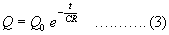 |
|
|
In particular, when t = CR, the
charge stored is |
|
|
 |
|
|
Thus, the time constant for a discharging circuit
is the time required for the charge to fall to 0.368 times its original
charge. |
|
|
|
|
| c. |
With
the aid of a circuit diagram, devise an experiment to charge a capacitor
at a constant rate. Derive an expression for the charging period in terms
of the capacitance and resistance in the circuit. Discuss how the experimental
result may deviate from your expression. |
6
marks |
|
|
|
|
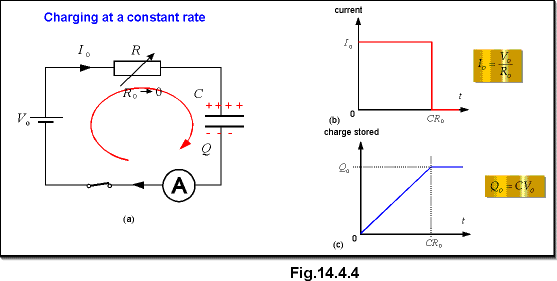 |
2 |
|
Before the switch is closed, R is set
to its highest value Ro. After the switch is closed,
R is adjusted to keep the current constant, until C is fully
charged. |
1 |
|
The constant current is equal to the initial
current |
|
|
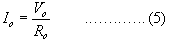 |
1 |
|
When C is fully charged, the current stops suddenly
and the p.d. across C is Vo. |
|
|
The time required is given by |
|
|
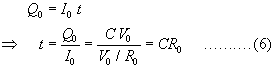 |
1 |
|
In practice, the current does not fall to zero
at t = CRo. This is because there is other resistance
in the circuit, for instance, the internal resistance of the cell, which
cannot be reduced in the course of discharging. |
1 |
|
|
|
|
|
|
|
|
|