| a. |
Explain
what is meant by relative permittivity. Describe an experiment using a
reed switch and two parallel plates to measure the relative permittivity
of polythene. |
6
marks |
|
|
|
|
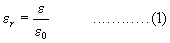
Different insulators have different permittivity
constant. If an insulator has a permittivity constant of e,
the relative permittivity is |
|
|
 |
|
|
where eo
is the permittivity in vacuum. |
1 |
|
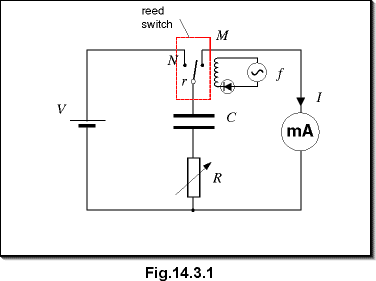
Measuring Capacitance
using a reed switch |
|
|
 |
1 |
|
In this experiment, the protecting resistance
R is adjusted until a further decrease in R would not affect
the discharging current I. When this happens, the capacitor is fully
charged and fully discharged in each cycle. |
1 |
|
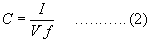
The capacitance is given by |
|
|
 |
|
|
where f is the frequency of the reed
switch and V is the voltage of the supply. |
1 |
|
To measure the relative
permittivity |
|
|
Starting using an air-filled parallel-plate
capacitor. The separation between the plate is exactly the same as the
thickness of the polythene sheet to be measured. Measure the capacitance
Co. |
|
|
Insert the sheet of polythene in between the
plates, filling all the gaps. Measure the capacitance C again. |
1 |
|
With a dielectric the capacitance is |
|
|
 |
1 |
|
This gives the relative permittivity er
of polythene. |
|
|
|
|
| b. |
With
reference to the molecular behaviour in a dielectric, explain why the capacitance
of a parallel-plate capacitor is increased by inserting a dielectric between
the two conducting plates. |
5
marks |
|
|
|
|
 |
2 |
|
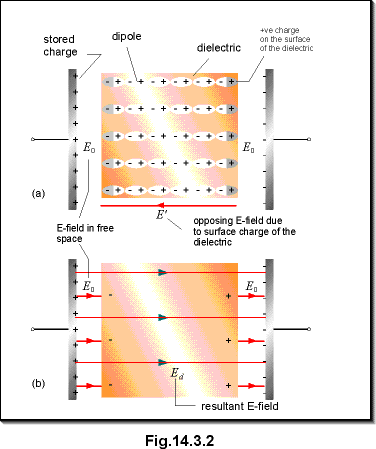
When an insulator (dielectric) is inserted
between the metal plates of a charged capacitor, the positive and negative
charages inside the molecules of the dielectric would move in opposite
directions, forming dipoles. If the insulator has permanent dipoles, these
dipoles would align themself inside the electric field. |
|
|
Thus, surface charges would be induced on the
dielectric. |
1 |
|
These induced charges set up an electric field
E', in a direction opposite to the original electric field Eo. |
|
|
As a result, the resultant electric field is reduced to |
|
|
E = Eo
- E' |
1 |
|
According to V = E d, the potential difference between
the plates would also decrease. |
|
|
For the same charge stored by the plates, a smaller p.d.
V means a higher capacitance C. |
1 |
|
|
|
| c. |
A
dielectric is used to separate the metal plates and to increase the capacitance
of a capacitor. State one more physical properties desirable in a material
to be used as the dielectric in a capacitor. Explain
i)
why water having a high value of relative permittivity is not commonly
used as dielectric |
5
marks |
|
|
|
|
The dielectric could reduce the chance of electric breakdown.
Thus, the working voltage of the capacitor is higher. |
2 |
|
|
|
|
Water is not used as dielectric because it
is conducting. |
1 |
|
|
|
|
ii)
why electrolytes, being a conductor, is found inside an electrolytic capacitor. |
|
|
|
|
|
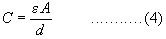
When an electrolytic capacitor is manufactured,
a very thin aluminium oxide is formed on one of the electrode plate. This
thin layer is not conducting. According to |
|
|
 |
|
|
a small d gives a very large C. |
2 |
|
|
|