| a. |
Discuss
the effects on the potential of a positively charged sphere, placed on
an insulating stand, when the following actions take place:
i)
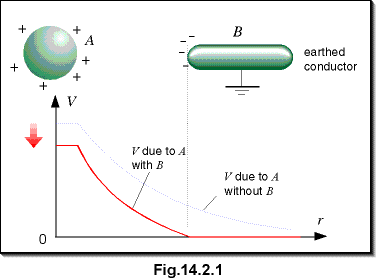
an earthed object is moved close to it |
6
marks |
|
|
|
|
 |
1 |
|
Negative charge would be induced on the earthed
sphere. This would decrease the potential of the positively charged sphere. |
1 |
|
|
|
|
ii)
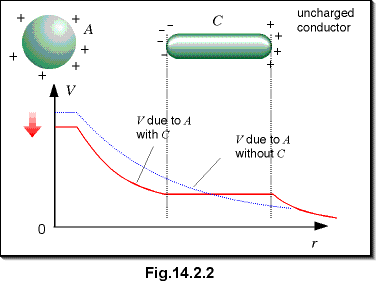
an uncharged object is moved close to it |
|
|
|
|
|
 |
1 |
|
Although both positive and negative charge
are found on the uncharged conductor, the induced negative charge is more
closed to A. Thus, the potential of A is decreased. |
1 |
|
|
|
|
iii)
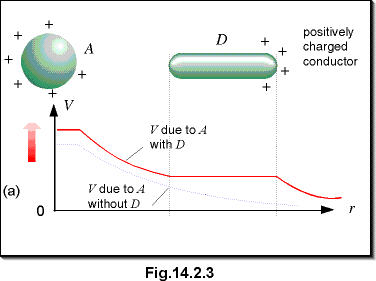
a positively-charged object held by an insulating handle is moved close
to it.
In each case, draw
a graph to show the variation of the potential in the space between the
sphere and the nearby object with the distance from the center of the sphere. |
|
|
|
|
|
 |
1 |
|
The positive charge on D would be added to
the potential of A. Thus, the potential of A is increased. |
1 |
|
|
|
| b. |
What
is meant by stray capacitance? Discuss how you can estimate the stray capacitance
of a parallel-plate capacitor, with the aid of a reed switch, or otherwise. |
5
marks |
|
|
|
|
Stray capacitance is the extra capacitance
caused by nearby earthed objects. Since the capacitor is not completely
isolated, the nearby earthed objects would reduce the potential difference
of the charged plates. As a result, the capacitance is more than the theoretical
value. |
|
|
In practice, the capacitance is |
|
|
C = Co
+ Cs |
|
|
where Co is the theoretical capacitance
and Cs is the stray capacitance. |
2 |
|
Using a reed switch
to measure capacitance |
|
|
 |
|
|
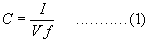
The capacitance is given by |
|
|
 |
1 |
|
where I is the current, V is
the voltage of the power supply and f is the frequency of the reed
switch. |
|
|
To measure the stray
capacitance |
|
|
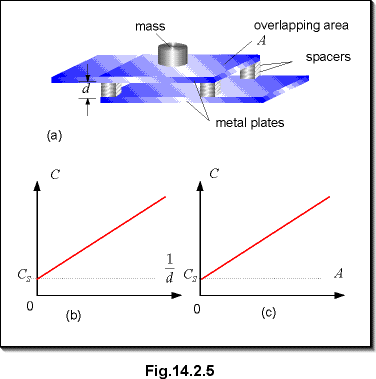
By varying the plate separation d and
the overlapping plate area A, different values of capacitance C
can be measured using a reed switch. Graphs of C against A
and C against 1/d are plotted. |
|
|
Results show the both graphs are straight line
that do not pass through the origin. The vertical intercepts represent
the stray capacitance. The average of the two intercepts gives the stray
capacitance of the capacitor. |
1 |
|
 |
1 |
|
|
|
| c. |
Explain
i)
how the charge stored in a parallel-plate capacitor could be measured |
5
marks |
|
|
|
|
 |
1 |
|
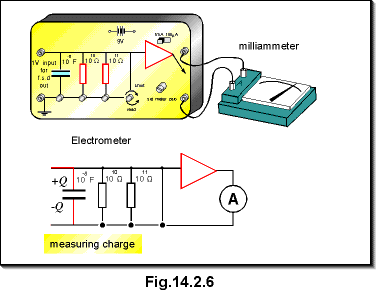
Charge could be measured by an electrometer. Select the
internal capacitor (10-8 F)and unselect the two internal resistors. |
|
|
Since the charge on the laboratory parallel-plate capacitor
is very small (~10-10 F), when it is in connection with the
internal capacitor of the electrometer, it would be almost fully discharged. |
1 |
|
The deflection on the milliammeter gives the input voltage
Vin which is the p.d. across the internal capacitor. Thus, the
charge is given by |
|
|
 |
1 |
|
|
|
|
ii)
how the voltage of a charged capacitor could be measured. |
|
|
|
|
|
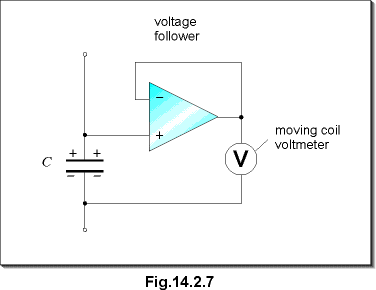
The voltage of a charged capacitor could be measured by
a moving coil voltmeter through a voltage follower. The voltmeter cannot
be connected directly across the capacitor since this would discharge it. |
1 |
|
A voltage follower is used because it has a very high input
resistance. |
|
|
 |
1 |
|
|
|