| a. |
Define
the capacitance of a parallel-plate capacitor. Starting from the first
principle, derive an expression for this capacitance and explain why your
expression is only approximately correct. |
6
marks |
|
|
|
|
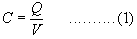
The capacitance
C of a capacitor is defined as the charge stored per unit voltage applied
across the capacitor. |
|
|
Mathematically, when the voltage V is
applied across a capacitor storing charge Q, the capacitance is |
|
|
 |
|
|
 |
|
|
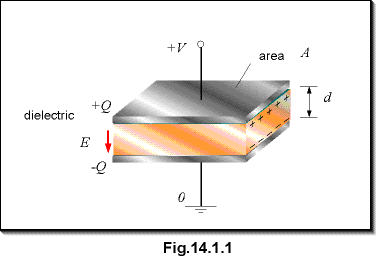
Consider the capacitor shown above. Suppose
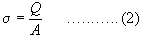
the magnitude of charge on each plate is Q. The surface charge density
is |
|
|
 |
|
|
where A is the area of each plate. |
|
|
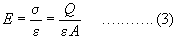
The electric field between the plates is |
|
|
 |
|
|
where e is the absolute
permittivity of the dielectric. |
|
|
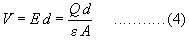
Since the electric field is uniform, the potential
difference is |
|
|
 |
|
|
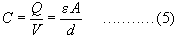
where d is the thickness of the dielectric.
Thus, the capacitance of the capacitor is |
|
|
 |
|
|
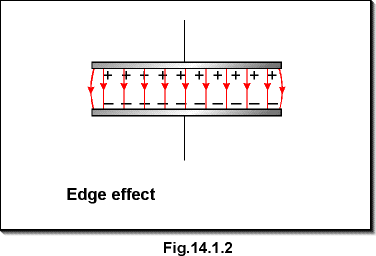
In practice, the electric field near the edge
of the parallel plates is not uniform: |
|
|
 |
|
|
Thus, the equation (5) is an approximation. |
|
|
|
|
| b. |
State
the functions of dielectrics in a capacitor. Describe briefly the structure
of
i)
a variable air capacitor |
4
marks |
|
|
|
|
Functions of dielectrics: |
|
|
-
to keep the plates apart
-
to increase the capacitance by a factor of er.
-
to reduce the chance of electric breakdown so that the capacitor can work
at a higher voltage.
|
2 |
|
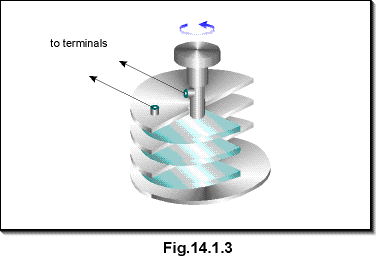
Variable air capacitor |
|
|
It consists of two sets of parallel plates
interleaving each other. The overlapping area can be varied by rotating
one set while keeping the other set fixed. This changes the capacitance
of the combination. |
1 |
|
 |
|
|
|
|
|
ii)
an electrolytic capacitor. |
|
|
|
|
|
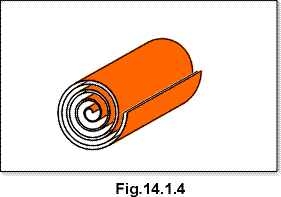
An electrolytic capacitor consists of two aluminium plates
separated by a paper soaked with a conducting solution. When it is manufactured,
a very thin aluminium oxide is formed on the anode. This film forms a very
thin dielectric between the two plates. Thus, a very high capacitance can
be obtained. |
1 |
|
 |
|
|
|
|
| c. |
Describe
an experiment using an electrometer to investigate the charge stored in
a parallel-plate capacitor. The following aspects should be considered:
i)
the geometric arrangement of the plates |
|
|
ii)
the voltage across the plates and |
|
|
iii)
the dielectrics between the plates. |
6
marks |
|
|
|
|
 |
1 |
|
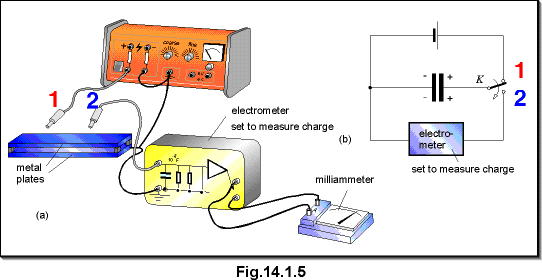
The lower plate of the parallel-plate capacitor
is earthed. The upper plate is charged by touching it momentarily with
the positive terminal of the EHT. Then, the charge is measured by an electrometer. |
1 |
|
Geometric arrangement |
|
|
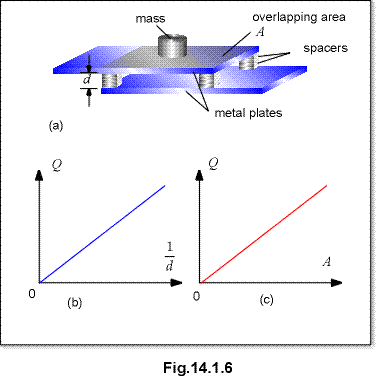
The overlapping area A is changed by sliding the
upper plate sideway. The separation d between the plates is changed
by changing the amount of the spacers. |
1 |
|
Graphs of Q vs A and Q
vs 1/d are plotted. Results show that the charge stored is proportional
to A and inversely proportional to d. |
|
|
 |
1 |
|
Voltage across the
plates |
|
|
This is changed by varying the output voltage of the EHT.
Results show that when the voltage is increased, the charge stored would
increase accordingly. |
1 |
|
Dielectrics |
|
|
The space between the plates can be replaced by whole sheet
of perspex. Results show that charge storage is increased by inserting
the perspex inside. |
1 |
|
|
|
|
|
|
|
|
|