| a. |
Define
the electric potential V and the electric field strength E at a point.
How are they related? Write down the expressions for V and E with reference
to an isolated charged sphere. |
5
marks |
|
|
|
|
The electric potential V at a point is the
work done per coulomb required to bring a positive charge from infinity
to that point. |
|
|
The electric field strength E at a point is
the force per unit test charge placed at that point. |
|
|
For a uniform field, |
|
|
 |
|
|
(For a non-uniform field, |
|
|
 ) ) |
|
|
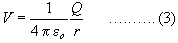
For an isolated sphere carrying charge Q,
the electric potential at r is |
|
|
 |
|
|
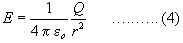
and the electric field strength at r
is |
|
|
 |
|
|
|
|
| b. |
Consider
a charged pear-shaped solid conductor.
i)
Explain why the excessive charges reside only on the surface of the conductor. |
6
marks |
|
|
|
|
Since the excessive charges are free to move inside the
conductor and they repel each other, they would move away from one another.
As a result, we can only find excessive charges on the surface. |
1 |
|
|
|
|
ii)
Describe and explain how the electric field strength E varies along the
surface of the conductor. |
|
|
|
|
|
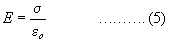
The electric field strength is proportional
to the surface charge density: |
|
|
 |
1 |
|
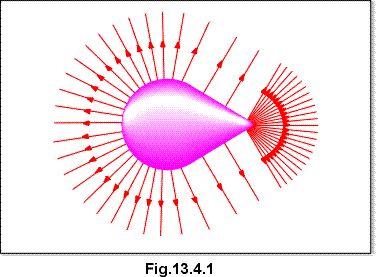
Since there is higher charge density on the
curved surface than the flat surface, the electric field is highest at
the tip and smallest in the chunk. |
1 |
|
 |
1 |
|
|
|
|
iii)
Explain why the direction of the electric field is always normal to the
surface at the point concerned. |
|
|
|
|
|
If the field is not normal to the surface,
there would be a component on the surface. This would cause the free electrons
to move. |
1 |
|
|
|
|
iv)
Describe and explain how the potential varies over the surface of the conductor. |
|
|
|
|
|
The potential is the same everywhere on the
surface of a conductor. If there potential difference between any two points,
a current would flow around. |
1 |
|
|
|
| c. |
Explain
why the electric field strength on the surface of a charged conductor has
a limiting value. Describe the action of points on a charged conductor
and give two practical applications of the effect. |
5
marks |
|
|
|
|
If the electric field is very large, the air
molecules around the surface would be ionized. Like charges are repelled
from the conductor and unlike charge would be attracted towards it. This
would decrease the electric field strength (the conductor discharges). |
2 |
|
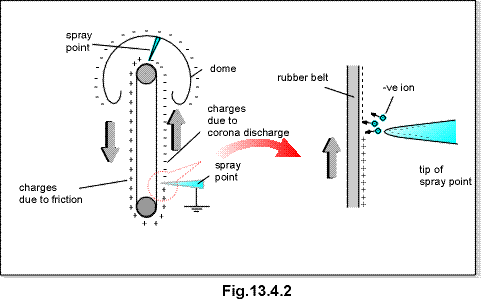
Excessive charges easily accumulate on the
sharp points. This would produce a very strong electric field. Ionization
of air molecules would occur. A stream of ions with the same charge as
the conductor would move out (electric wind). This is known as action of
points. |
1 |
|
Applications of action
of points |
|
|
-
Lightning conductor
-
van de Graaff generator
|
2 |
|
 |
|
|
|
|