| a. |
What
is an electric field? Explain clearly
i)
how the strength of an electric field is defined |
4
marks |
|
|
|
|
An electric field is a region in which an electric
charge experience a force. |
1 |
|
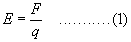
The electric field strength E at a point
is defined as the force per unit test charge placed at that point. |
|
|
Mathematically, if a test charge q experiences
an electric force F, then the field strength at the position of
the test charge is |
1 |
|
 |
|
|
|
|
|
ii)
how you can represent an electric field schematically. |
|
|
|
|
|
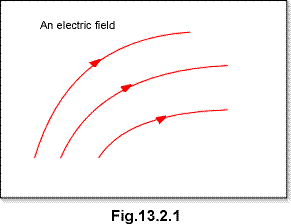
An electric field is usually represented by directed lines.
The direction of the arrow represents the direction of force acting on
any positive test charge. |
1 |
|
 |
1 |
|
|
|
| b. |
What
do you understand about a uniform electric field? Describe how you can
establish such a field and suggest how you can verify that the field is
uniform. |
4
marks |
|
|
|
|
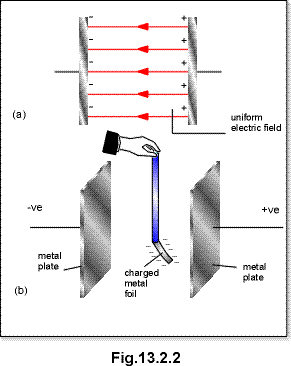
A uniform electric
field is one in which the electric field strength is the same
everywhere (independent of the position of the test charge). |
1 |
|
A uniform field can be set up by two parallel
plates maintained at different potentials. |
1 |
|
To verify that the field is uniform, we can
use a strip of charged metal foil attached to an insulated rod. The angle
of deflection of the foil depends on the electric force (hence the electric
field strength). Results show that the angle of deflection is independent
of the position of the foil. |
1 |
|
 |
1 |
|
|
|
| c. |
A
positively charged particle is projected with an initial speed in a uniform
electric field. Describe the subsequent motion of the particle, if the
initial velocity is
i)
in the same direction as the electric field lines |
3
marks |
|
|
|
|
Since the particle is positively charged, the electric
force on it is always along the field lines. |
|
|
Since the electric force is in the same direction
as the initial velocity, the particle accelerates (moves with increasing
velocity) in a straight line. |
1 |
|
|
|
|
ii)
in the opposite direction as the electric field lines |
|
|
|
|
|
Since the electric force is in the opposite
direction as the initial velocity, the particle decelerates until it is
instantaneously at rest and then accelerates in the opposite direction.
The path is a straight line. |
1 |
|
|
|
|
iii)
at an angle less than 90o to the electric field lines.
No mathematical
derivation is required. |
|
|
|
|
|
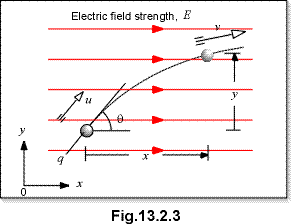
The velocity component at right angles to the
field lines is unaffected by the electric force (thus, remains constant
throughout). The velocity component parallel to the field lines increases
continuously. The path is a parabola. |
|
|
 |
|
|
|
|
| d. |
What
is an equipotential surface? Describe an experiment to investigate the
equipotential lines between two electrodes. |
5
marks |
|
|
|
|
An equipotential surface
is an imaginary surface on which the potential is the same at all points. |
1 |
|
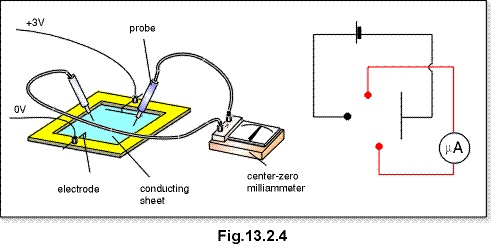
Plotting equipotential
lines |
|
|
 |
2 |
|
A d.c. voltage is applied across the electrodes.
A potential gradient exists on the conducting sheet. If there is p.d. between
the probes, the meter would deflect. The two probes are moved slowly on
the sheet, until the meter does not deflect. Then the probes lie on the
same equipotential surface. Hold one probe and then move the other, keeping
null deflection on the meter. An equipotential line can be plotted. |
2 |
|
|
|