| a. |
How
do
i)
the magnitude of the gravitational field, and |
2
marks |
|
|
|
|
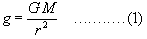
The gravitational field strength is |
|
|
 |
|
|
Thus, g varies inversely proportional
to the square of the distance from the point mass. |
|
|
|
|
|
ii)
the magnitude of the electric field,
vary with distance
from a point mass and a point charge respectively? |
|
|
|
|
|
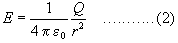
The electric field strength is |
|
|
 |
|
|
Thus, E varies inversely proportional
to the square of the distance from the point mass. |
|
|
|
|
| b. |
Assume
that the Earth is a homogeneous spherical mass with radius R. Sketch a
graph to illustrate the variation of gravitational field strength g with
distance r from the centre of the Earth. Explain the shape of your graph
for r > R. |
3
marks |
|
|
|
|
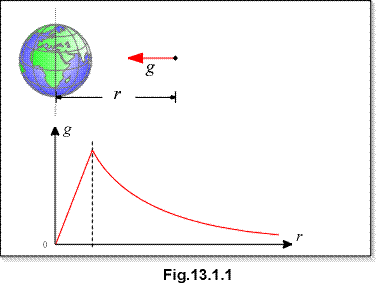
According to the Shell theorem, the gravitational field
at a point external to a thin uniform spherical shell of mass M
is equivalent to the field caused by a point mass M at the centre
of the shell. |
1 |
|
The Earth can be regarded as made up of many
uniform shells. Each shell can be treated as a point mass at the Earth's
center. Thus, to an external point the field varies inversely with the
square of the distance from the Earth's center. |
1 |
|
|
|
|
 |
1 |
|
|
|
| c. |
Sketch
a graph to illustrate the variation of electric field strength E with distance
r from the centre of a positively charged solid metal sphere of radius
a. Explain the shape of your graph for r < a and r > a. |
4
marks |
|
|
|
|
 |
2 |
|
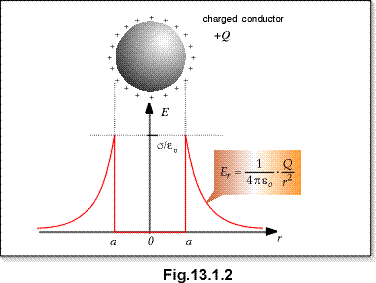
The electric field inside conductor in electrostatic
is zero, otherwise, a current would flow. |
1 |
|
Since the excessive charges accumulate on the
surface of the sphere, they form a uniform sphere of charge. According
to the Shell Theorem, the conductor can be regarded as a point charge at
the centre. Thus, the electric field varies inversely with the square of
the distance from the centre of the sphere. |
1 |
|
|
|
|
|
|
| d. |
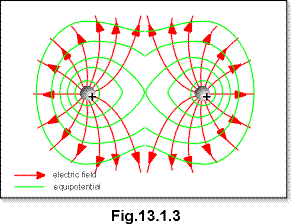
Sketch
i)
the electric field pattern for two equal like charges. |
7
marks |
|
|
|
|
 |
2 |
|
|
|
|
ii)
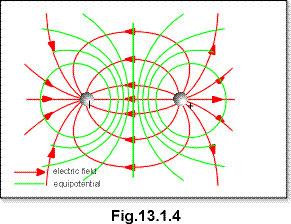
the electric field pattern for two equal but opposite charges. |
|
|
|
|
|
 |
2 |
|
|
|
|
iii)
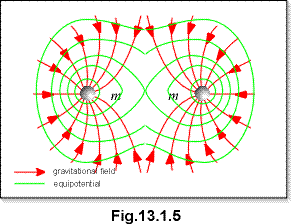
the gravitational field pattern for two equally massive point masses.
On each of your
field pattern, using different colors of pen, roughly sketch the equipotential
lines. |
|
|
|
|
|
 |
3 |
|
|
|