| a. |
Explain
what is the normal adjustment for an optical instrument. Illustrate your
answer with two different examples. |
2
marks |
| |
|
|
|
An optical instrument is in normal
adjustment when the final image is formed at a position where
the user expects to see. |
1 |
|
A microscope should form the final image at
the near point (the least distance of distinct vision). |
0.5 |
|
A telescope should form the final image at
the far point (infinity). |
0.5 |
| |
|
|
| b. |
Draw
a diagram to show the passage of light rays through a simple astronomical
refracting telescope when it is used in normal adjustment. Derive an expression
for its angular magnification. |
4
marks |
| |
|
|
|
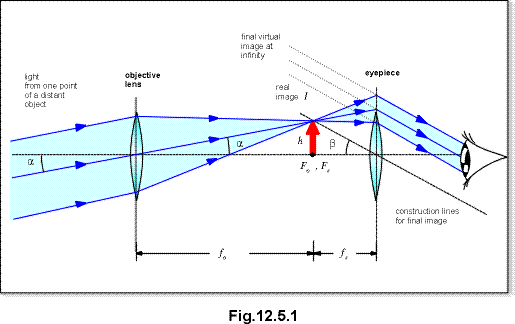 |
2 |
|
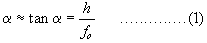
Without the telescope, the visual angle of the distant
object is |
|
|
 |
0.5 |
|
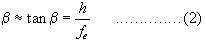
With the telescope, the final image is at infinity. The
visual angle of the final image is |
|
|
 |
0.5 |
|
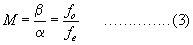
Thus, the angular magnification is |
|
|
 |
1 |
| |
|
|
| c. |
A
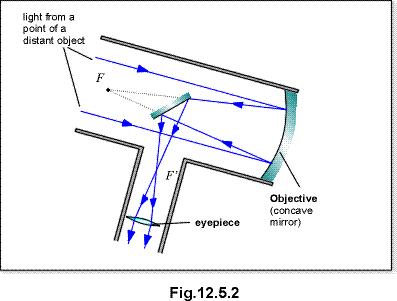
reflecting telescope is similar to a refracting telescope, except that
the objective lens of the refracting telescope is replaced by a concave
mirror. Draw a diagram to show how the final image could be viewed when
the reflecting telescope is used in normal adjustment. Explain the advantages
of using a reflecting telescope over a refracting telescope. |
4
marks |
| |
|
|
|
 |
1 |
|
Advantages of using a reflecting
telescope: |
|
|
-
The objective mirror does not reduce as much light intensity as objective
lens.
-
In reflecting telescope, there is no problem of chromatic aberrration.
Lens produces a fringe of false colors around the image star, as different
colors of light have different refractive indices.
-
Spherical aberration can be eliminated by making the reflecting surface
paraboloial.
-
A large mirror can be built easily and inexpensively, compared to a large
lens.
-
A mirror can be supported from beneath over all area, while a lens can
only be held over its rim.
|
any 3 |
|
|
|
| d. |
What
is the eye ring of an optical instrument? Show that, in a refracting telescope,
the eye ring is the position of the image of the objective lens produced
by the eyepiece. |
3
marks |
|
|
|
|
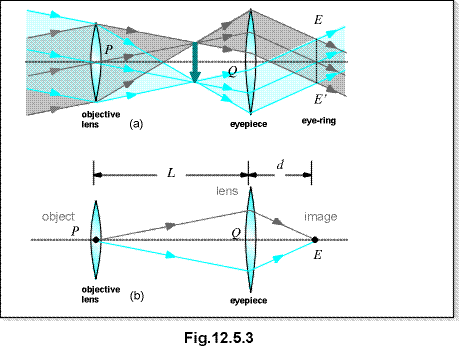
Eye ring is the position
of the eye, when using an optical instrument, at which most light enters
the eye. |
1 |
|
 |
1 |
|
From the diagram, all the light rays from the distant object
entering the telescope pass through the circular region EE'. Thus,
EE' is the position of the eye ring. |
|
|
Consider the two light rays that pass through
the optical center. They will converge to a point on the line EE'
after refraction by eyepiece. P is the position that the eyepiece
will produce a real image at E. Thus, the eye ring is the image
position of the objective lens by the eyepiece. |
1 |
|
|
|
| e. |
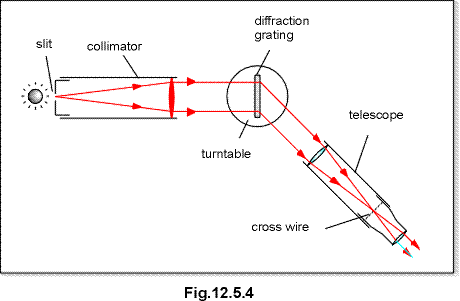
Draw
a simple diagram for a spectrometer. Assume that the turntable of a spectrometer
has been levelled. Describe other adjustments that have to be made before
the instrument can be used. |
3
marks |
| |
|
|
|
 |
1 |
|
Adjustments before use |
|
|
-
Adjust the telescope to receive parallel light. Turn the telescope to view
a distant object and then adjust the eyepiece until the image is focused
at the cross wire.
-
Adjust the collimator to transmit parallel light. Align the telescope with
the collimator. Change the position of the slit of the collimator until
it is seen clearly by the telescope.
|
2 |
|
|
|