| a. |
Give
an account on the difference between linear magnification and angular magnification. |
2
marks |
|
|
|
|
Linear magnification
is defined as |
|
|
 |
1 |
|
Angular magnification
is defined as |
|
|
 |
1 |
|
|
|
| b. |
Draw
a ray diagram to show the arrangement of a convex lens used as a magnifying
glass that results in a virtual image at the near point of the observer.
Explain why the visual angle is increased when the magnifying glass is
used. State the physical factors that limit the magnification of a magnifying
glass. |
5
marks |
|
|
|
|
 |
2 |
|
Without the magnifying glass, the maximum visual angle
of the object is |
|
|
 |
1 |
|
where D is the least distance of distinct vision.
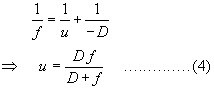
In normal adjustment, the final image is at the near point. The object
distance from the lens is given by |
|
|
 |
|
|
The new visual angle is |
|
|
 |
1 |
|
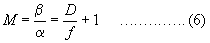
The angular magnification is |
|
|
 |
|
|
Since M > 1, the visual angle is increased. |
|
|
M cannot be increased indefinitely by simply reducing
f. This is because if f is too small, the lens would be too
thick and the image would be badly distorted. |
1 |
|
|
|
| c. |
A
compound microscope consists of two convex lenses and the final image is
formed at the near point of the observer. With the aid of a ray diagram,
show that the angular magnification of a compound microscope is the product
of the linear magnification of the objective lens and the linear magnification
of the eyepiece. |
6
marks |
| |
|
|
|
 |
2 |
|
Without the magnifying glass, the maximum visual angle
of the object is |
|
|
 |
1 |
|
Without the magnifying glass, the visual angle
of the final image is |
|
|
 |
1 |
|
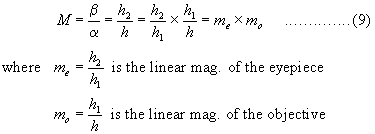
The angular magnification is |
|
|
 |
2 |
| |
|
|
| d. |
Devise
an experiment to measure the focal length of a diverging lens with the
help of either a converging mirror or a converging lens |
3
marks |
| |
|
|
|
Method 1 |
|
|
 |
|
|
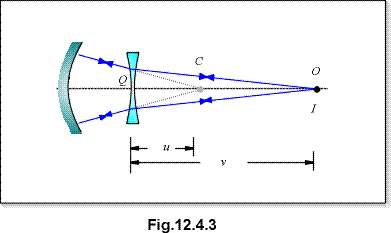
Adjust the positions of the lens and the object
until the image is formed at the same position as the object. |
|
|
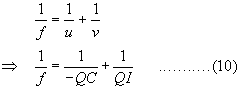
The distance between the lens and the center of curvature
of the mirror is the object distance. It is a virtual object. Thus, u
= -QC. The image is real. Thus, v = QI. |
|
|
The focal length of the lens is given by |
|
|
 |
|
|
|
|
|
Method 2 |
|
|
 |
|
|
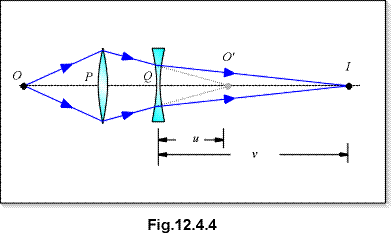
Without the diverging lens, the real image is formed at
O'. With the diverging lens, the real image is now located at I.
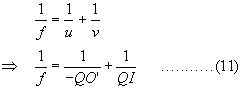
Now, O' is a virtual object for the diverging lens. Thus, u
= -QO'. The image distance is v = QI. |
|
|
The focal length of the lens is given by |
|
|
 |
|
|
|
|