| a. |
What
do you understand by visual angle? Use this to explain why a coin held
near the eye may have the same apparent size as a moon. |
2
marks |
| |
|
|
|
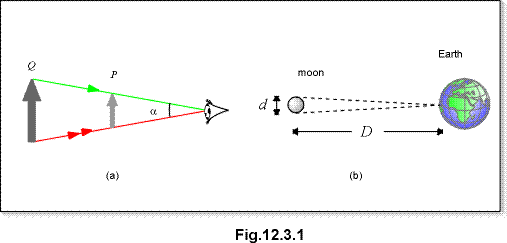
Visual angle of an object is the angle subtended
by the object at the eye. It determines the size of image on the retina.
So, it determines the apparent size of the object. |
1 |
|
 |
|
|
The moon subtends a small angle at our eyes:. |
|
|
 |
0.5 |
|
When a coin is placed closed to the eye, the
visual angle may be larger than that of the moon, and so appears to be
larger. |
0.5 |
| |
|
|
| b. |
Using
suitable ray diagrams, describe how accommodation for objects at different
positions can be achieved in
i)
the human eye. |
6
marks |
| |
|
|
|
Human eyes accomodate by varying the focal length of the
eye lens. |
|
|
To view near objects, the ciliary muscle contracts, increasing
the thickness of the lens and reducing the focal length. |
|
|
To view distant objects, the ciliary muscle relaxes, reducing
the thickness of the lens and increasing the focal length. |
|
|
 |
|
| |
|
|
|
ii)
the camera. |
|
| |
|
|
|
A camera accomodates by varying the position of the lens
relative to the film. |
|
|
To focus near objects, the lens moves outward (away from
the film). |
|
|
To focus distant objects, the lens moves inward (towards
the film). |
|
|
 |
|
| |
|
|
| c. |
Give
an account on the following common optical defects of the human eye
i)
shortsightedness |
8
marks |
| |
|
|
|
 |
2 |
|
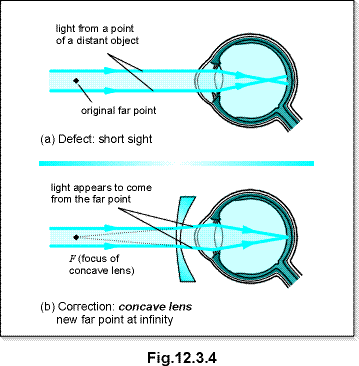
A short-sighted person can see near objects clearly but
cannot focus on distant objects. The image of a distant object is focused
in front of the retina because the focal length of the eye is too short
for the length of the eyeball (see Fig.a). |
1 |
|
This can be corrected by suitable concave lens (see Fig.b). |
|
|
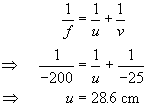
Suppose a short-sighted person can see clearly
objects between 25 cm to 200 cm. The focal length of the correcting concave
lens is f = -200 cm. The new far point is now at infinity. But the
new near point is given by |
|
|
 |
|
|
Thus, the range of vision is smaller than a
normal eye. |
1 |
| |
|
|
|
ii)
long-sightedness.
Explain how these
effects may be corrected. Show that after corrections are made, the ranges
of vision in both cases are less than a normal eye. |
|
| |
|
|
|
 |
2 |
|
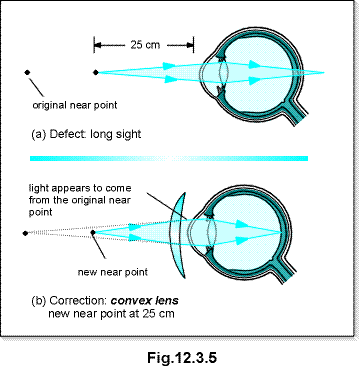
A long-sighted person can see distant objects clearly but
cannot focus on near objects. The image of a near object is focused behind
the retina because the focal length of the eye is too long for the length
of the eyeball (see Fig.a). |
1 |
|
This can be corrected by suitable convex lens (see Fig.b). |
|
|
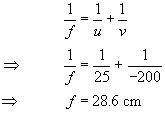
Suppose a long-sighted person can see clearly
objects between 200 cm to infinity. The focal length of the correcting
convex lens is given by |
|
|
 |
|
|
Since the images for objects at 28.6 cm are
now at infinity, the new far point is 28.6 cm. |
|
|
Thus, the range of vision is only between 25
cm and 28.6 cm. |
1 |
|
|
|