| a. |
A
beam of light travelling along a fixed direction strikes on a plane mirror
which can be rotated about the point of incidence. Show that the reflected
light beam would turn through an angle equal to twice the angle of rotation
of the mirror. Give one application of a rotating mirror. |
3
marks |
|
|
|
|
 |
1 |
|
When the mirror rotates through angle q,
the angle of incidence changes from i to i + q.
Since the angle of reflection equals the angle of incidence, |
|
|
 |
|
|
Thus, |
|
|
 |
|
|
The angle of deviation of the reflected ray
is |
|
|
 |
1 |
|
Applications of rotating
mirror |
|
|
Light beam galvanometer |
1 |
| |
|
|
| b. |
A
plane mirror is moving towards a fixed object at a constant speed. Show
that the image formed by the plane mirror would move towards the object
at a higher speed. |
2
marks |
|
|
|
|
 |
1 |
|
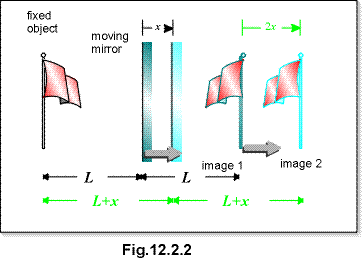
Suppose an object is located L from
a mirror. The distance between the object and its image is 2L.
When the mirror is moved to the right through x. The new object
distance is L+x. The new distance between the object and its image
is 2L+2x. |
|
|
The distance moved by the image is d
= 2L+2x - 2L = 2x. |
0.5 |
|
Thus, the image is moved at a speed twice as
the mirror. |
0.5 |
|
|
|
| c. |
Give
an account on the differences between a virtual image and a real image.
Draw ray diagrams to show how the image of the moon could be observed using
i)
a plane mirror |
5
marks |
|
|
|
|
A real image can be projected on a screen,
while a virtual image cannot. |
1 |
|
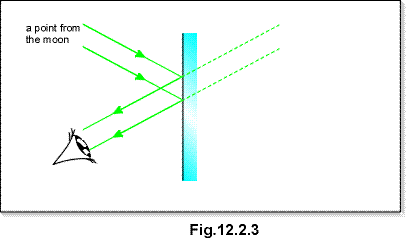
Viewing the Moon in
a plane mirror |
|
|
 |
2 |
| |
|
|
|
ii)
a concave mirror. |
|
| |
|
|
|
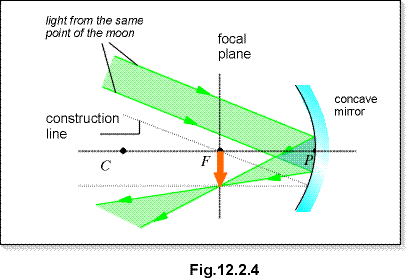
Viewing the Moon in
a concave mirror |
|
|
 |
|
| |
|
|
| d. |
With
the aids of diagrams, describe the spherical aberrations of
i)
a spherical concave mirror |
4
marks |
| |
|
|
|
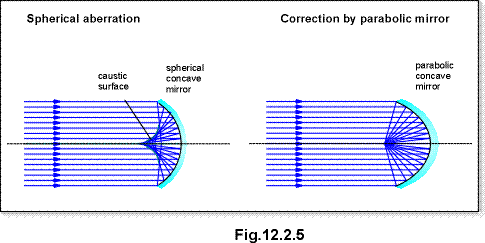
Spherical aberrations
occurs when parallel beams of light along the principal axis do not all
pass through the focus. |
|
|
 |
2 |
| |
|
|
|
ii)
a convex lens.
For each case, state
how the spherical aberration can be corrected. |
|
| |
|
|
|
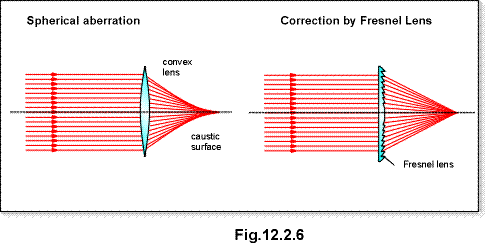 |
2 |
| |
|
|
| e. |
Explain
why color fringes are usually observed around a sharply focused image by
a convex lens. |
2
marks |
| |
|
|
|
Color fringes are observed because light of
different frequency (colour) has different refractive index in glass. Thus,
they are bent by different amounts by the lens. |
|
|
In particular, violet light bends more than
red lights. This effect is known as chromatic
aberration. |
2 |
|
|
|