| a. |
What
is meant by the refraction of light? State how the absolute refractive
index of a medium is defined. A beam of light travels across the interface
between two media, making an angle with the normal. Explain how the angle
of refraction depends on the absolute refractive indices of the media. |
5
marks |
| |
|
|
|
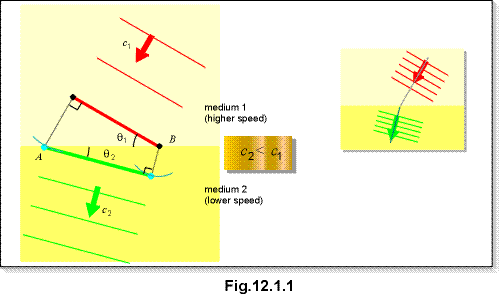
Refraction
of light occurs when light travels obliquely from one medium to another
accompanied with a change in the direction of propagation. This is resulted
from a change in light speed across the boundary of the two media. |
1 |
|
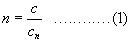
Absolute refractive
index of a medium is defined as the ratio of the speed of light
in vacuum, c, to the speed of light in the medium, cn. |
1 |
|
 |
|
|
 |
1 |
|
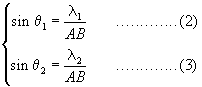
For light travelling from medium 1 to medium
2, the angles that the wavefronts makes with the boundary are the angles
of incidence and refractions respectively. |
|
|
 |
1 |
|
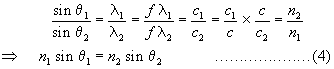
The frequency of light remains unchanged during
refraction |
|
|
 |
1 |
| |
|
|
| b. |
Explain
how the letters on a paper shift in position as a thick glass block is
placed on top of the paper. Derive an expression for the image position
of the letters in terms of the refractive index of glass and the thickness
of the glass block as the letters are viewed normally through the glass
block. Describe an experiment to measure the refractive index of glass
using the principle. |
5
marks |
| |
|
|
|
 |
1 |
|
When a glass block is placed on the paper, the letters
are shifted upward. |
|
|
Consider the refraction at A. Assuming that A
is close to the normal, i.e. AB is small. The real depth (thickness
of glass block), dreal, and apparent depth (image position),
dapp, are related as |
|
|
 |
1 |
|
 |
1 |
|
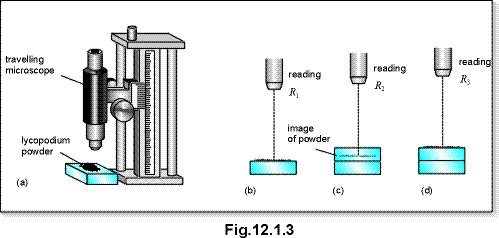
Spread evenly some powder on a glass block. Focus the travelling
microscope on these powder. Mark the reading R1. |
|
|
Place another glass block on top. The image of the powder
shifts up. Focus the microscope on the image of the powder. Mark the reading
R2. Now, spread some powder on the top surface. Again
focus the microscope to give reading R3. |
1 |
|
The real thickness of the upper glass block is dreal
= R3 - R1. |
|
|
The apparent thickness of the upper glass block is dapp
= R3 - R2. |
|
|
The refractive index of the upper glass block is |
|
|
 |
1 |
| |
|
|
| c. |
Using
Huygen’s principle, derive a condition of light for total internal reflection
to occur at the air-glass interface. Give one everyday application of the
total internal reflection of light. |
6
marks |
| |
|
|
|
 |
1 |
|
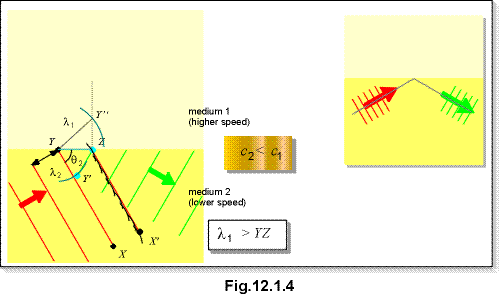
Consider the wavefront XY. After one period,
X becomes X'. If the wave refracts, then Y becomes Y''. However, YY'' is
greater than YZ. i.e. l1 > YZ. It
is impossible to construct a continuous wavefront with wavelets in medium
1. |
0.5 |
|
Thus, refraction is impossible. |
|
|
If reflection occurs, Y becomes Y'. This is
possible. Thus, the wave undergoes total internal reflection and propagates
in medium 2. |
0.5 |
|
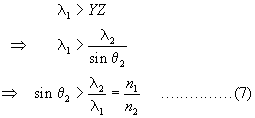
From the diagram, the condition for total internal reflection
to occur is |
|
|
 |
1 |
|
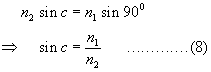
When the angle of refraction is 90o,
the angle of incidence (called critical angle), c, is given by |
|
|
 |
1 |
|
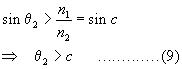
Thus, the conditions for total internal reflection
to occur is |
|
|
 |
1 |
|
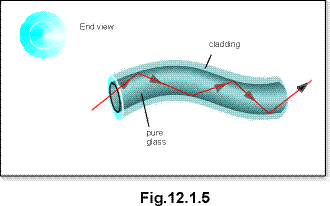
An application of total internal reflection
is optical fibre. |
|
|
 |
1 |