| a. |
A
student claims that the wave energy at the position of destructive interference
is zero because the wave energy is destroyed there. Comment on the claim
of the student. |
2
marks |
| |
|
|
|
The student's claim is incorrect. Energy cannot
be destroyed (nor can it be created). |
1 |
|
Interference is effectively an re-distribution
of energy. |
0.5 |
|
Positions of constructive interference receive
more energy, at the expense of the positions of destructive interference. |
0.5 |
| |
|
|
| b. |
Sketch
the experimental arrangement that could give rise to the formation of Newton’s
rings. Explain carefully the following observations:
i)
a dark fringe is formed at the center of the Newton’s rings when the reflected
light is viewed |
8
marks |
| |
|
|
|
 |
2 |
|
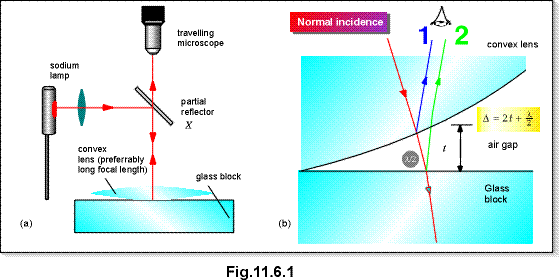
Interference occurs between light reflected at the upper
(ray 1) and lower (ray 2) surfaces of the air-gap. |
|
|
There is no phase change for ray 1. But ray 2 undergoes
p phase change. |
1 |
|
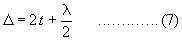
The overall optical path difference between the two rays
is |
|
|
 |
|
|
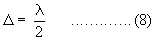
At the center of the Newton's ring, the thickness t
is zero. Thus, the optical path difference is |
|
|
 |
|
|
This corresponds to destructive interference. Hence, a
dark spot is seen. |
1 |
| |
|
|
|
ii)
a bright fringe is formed at the center when the transmitted light is viewed |
|
| |
|
|
|
Since the optical path for the two transmitted ray is zero,
constructive interference occurs. Thus, the centre of the rings for transmitted
light is bright. |
1 |
|
|
|
|
iii)
the density of rings increases at higher orders. |
|
| |
|
|
|
 |
1 |
|
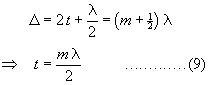
From equation (7), the thickness of the mth
dark fringe is given by |
|
|
 |
|
|
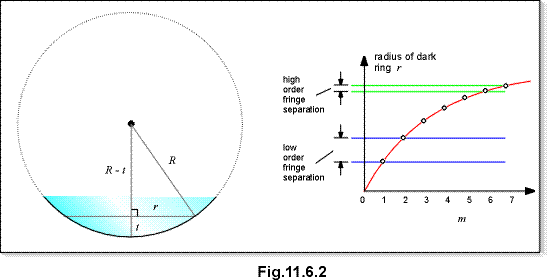
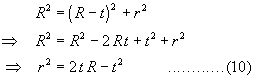
Let R be the radius of curvature of
the lens surface. The radius of the ring r is given by |
|
|
 |
1 |
|
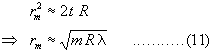
Since t is small, t2
is negligible. Thus, the radius of the mth ring is given by |
|
|
 |
1 |
|
Thus, as m increases, the rate of increases
of r is not as rapid, i.e. The rings become denser for higher order. |
|
| |
|
|
| c. |
An
interferometer consists of a 45o-partial reflector that splits
a beam of monochromatic light into two. After reflections by two mirrors,
the two beams of light recombine to produce an interference pattern. Sketch
a diagram to show an interferometer. Describe and explain the result of
interference as one of the mirrors is gradually moved away from the partial
reflector. |
6
marks |
| |
|
|
|
 |
2 |
|
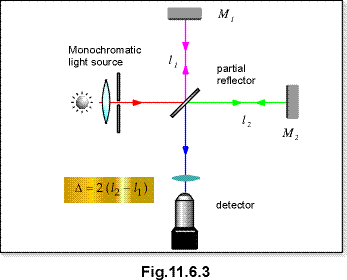
Light is split into two paths l1
and l2 by the partial reflector. After reflection by
mirrors M1 and M2 respectively, they
reach the same detector. |
1 |
|
The overall optical path difference between
the two rays is |
|
|
 |
1 |
|
If one of the mirrors moves, then the optical
path will change. |
1 |
|
A bright fringe would be detected when |
|
|
 |
|
|
A dark fringe would be observed when |
|
|
 |
|
|
Thus, alternate bright and dark fringes would
be observed. |
1 |