| a. |
Discuss
the advantage of minimizing the reflection of light from a glass lens.
With the aid of a diagram, explain how this can be achieved. State the
limitations of such technique. |
6
marks |
| |
|
|
|
The advantage of minimizing reflection: |
|
|
-
reduce glare caused by reflection
-
allow more light to transmit (improving transmission)
|
1 |
|
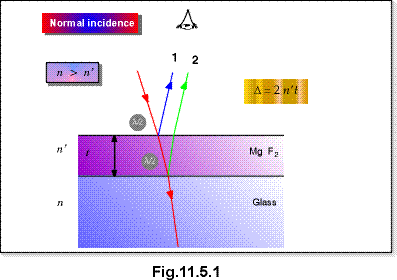
Blooming of lens |
|
|
 |
1 |
|
The glass lens is coated with a thin layer
of material (MgF2) which has a lower refractive index than glass
(n' < n). |
|
|
Light reflected at the air-coating interface
undergoes p phase change. |
0.5 |
|
Light reflected at the coating-glass interface
also undergoes p phase change. |
0.5 |
|
For destructive interference between the two
reflected rays, the thickness of the coating is given by |
|
|
 |
|
|
where m = 0, 1, 2, ... |
0.5 |
|
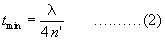
In particular, the minimum thickness of the
coating is |
|
|
 |
0.5 |
|
Limitations |
|
|
Exact cancellation of reflected light by coating
is suitable |
|
|
-
for a particular angle of incidence, e.g. normal incident only
-
for a particular color of light only
|
2 |
|
Thus, a coated lens also reflects sunlight
partially, sometimes giving reddish-green color. |
|
| |
|
|
| b. |
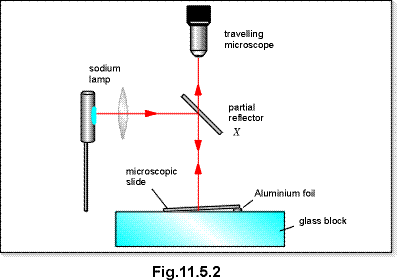
A
wedge of air is formed by placing a microscopic slide on a glass block
with one edge of the slide in contact with the block and the other edge
resting on a thin sheet of aluminium foil. Draw a labelled diagram of the
experimental arrangement you would use to observe the interference fringes.
Describe the fringes obtained and explain how the thickness of the aluminium
foil could be estimated. |
6
marks |
| |
|
|
|
 |
2 |
|
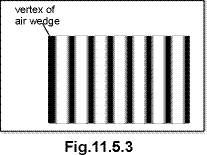
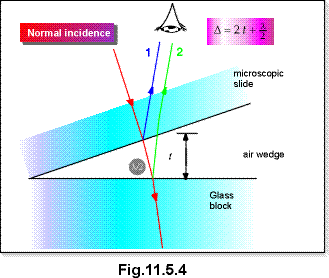
The interference pattern consists of evenly spaced parallel
bright and dark lines as shown below: |
|
|
 |
1 |
|
 |
1 |
|
Consider light reflected on the upper and lower surfaces
of the air wedge. |
|
|
There is no phase change for ray 1, but p
phase change for ray 2. |
1 |
|
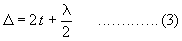
The overall optical path difference is |
|
|
 |
|
|
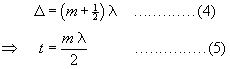
Suppose there are m dark fringes between the vertex
and the aluminium foil. The thickness of the aluminium foil is given by |
|
|
 |
1 |
| |
|
|
| c. |
Explain
the colors seen in a soap film formed by a vertical circular frame. Describe
how the color fringes change with time. |
4
marks |
| |
|
|
|
 |
1 |
|
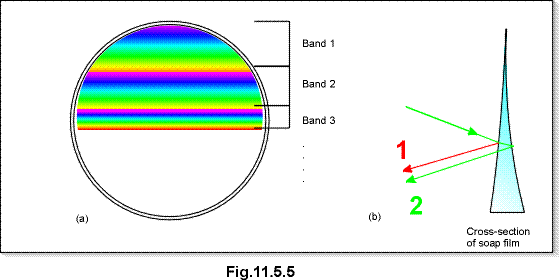
The soap film is visible because of reflection
of light. |
|
|
Light undergoes two reflections, one at the
near surface (path 1) and the other at the far surface (path 2). |
|
|
Ray 1 undergoes p
phase change. But, there is no phase change for ray 2. |
1 |
|
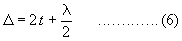
Suppose the thickness of the soap thin is t.
Assuming normal incidence, the overall optical path is |
|
|
 |
|
|
Since the thickness varies with position, the
optical path varies. Thus, there are positions of maximum and minimum along
the film.
Also, the optical path depends on the color of light. Thus, color fringes
occur. |
1 |
|
The cross section of the soap film is not a
uniform wedge. As time goes by, water drains down. So, it is thicker near
the bottom. The fringes becomes closer together near the bottom. |
0.5 |
|
When less and less water exists near the top,
the thickness t becomes zero. Then, a dark region exists near the
top before the film breaks. |
0.5 |