| a. |
Sketch
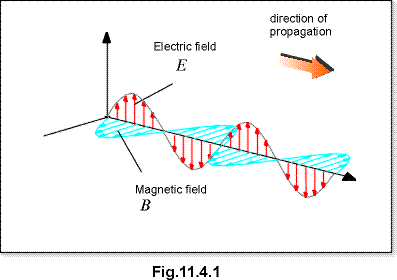
a diagram to represent an electromagnetic wave propagating in free space.
Discuss how radio waves are detected by a vertical antenna. |
3
marks |
| |
|
|
|
Electromagnetic wave consists of oscillating
electric field and magnetic field. |
|
|
 |
1 |
|
An antenna is a conducting rod in which electrons
are free to move. |
0.5 |
|
When a vertical antenna intercepts an EM wave,
the vertical component of the electric field would set the electrons of
the antenna into oscillation at the same frequency as the wave. |
1 |
|
Thus, a varying current is produced. |
0.5 |
| |
|
|
| b. |
Give
two reasons to explain why microwaves are used in satellite communication
instead of radio waves. |
2
marks |
| |
|
|
|
-
Radio waves of frequency below 30 MHz are reflected by the ionosphere.
-
Radio waves having a lower frequency (lower bandwidth) carries less signal
than microwaves.
|
1,1 |
|
|
|
| c. |
Describe
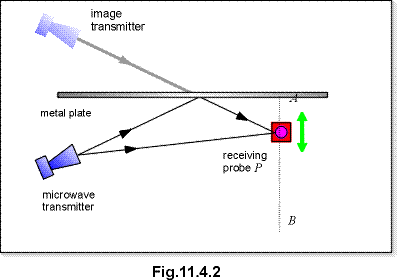
an experiment to demonstrate the interference of microwaves emitted directly
from a microwave transmitter and the reflected waves from a metal reflector.
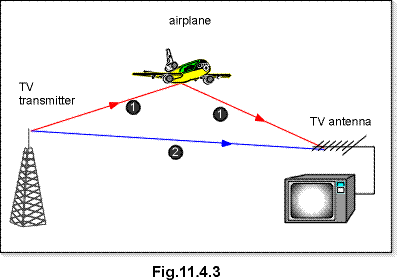
Hence, explain the fluttering of TV pictures as a low flying airplane passes
by. |
4
marks |
| |
|
|
|
 |
1 |
|
Direct the microwave transmitter at an angle
towards a large metal plate as shown. |
0.5 |
|
Maxima and minima might be detected as a receiving
probe is moved in and out at right angles to the metal plate (along AB
as shown). |
0.5 |
|
The interference pattern is explained by considering
the image of the transmitter as another source which is p
out of phase with the transmitter. |
1 |
|
Fluttering TV pictures |
|
|
 |
|
|
Radio waves could reach the antenna by either
reflected by the airplane (path 1) or directly (path 2). The path difference
between the two waves varies as the airplane moves. Thus, the received
signal varies in intensity. |
1 |
| |
|
|
| d. |
Explain
why the experiment described in (c) is difficult to repeat successfully
with light. |
2
marks |
| |
|
|
|
An interference pattern requires the source
separation to be of the same order as the wavelength. Since the wavelength
of light is very small (~10-7 m), the light source has to be
placed very close to the reflecting surface. |
2 |
|
|
|
| e. |
A
beam of white light falls on a diffraction grating. Show that the second
order and the third order color spectra are not pure spectra. Hence, explain
how you can obtain a pure spectrum of the sunlight from a diffraction grating. |
5
marks |
| |
|
|
|
The range of wavelength of visible light is
from 400 nm (violet) to 700 nm (red). |
|
|
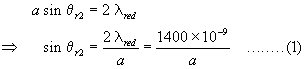
Let a be the slit separation of the
diffraction grating. |
|
|
The angular position of the 2nd order red light
is given by |
|
|
 |
1 |
|
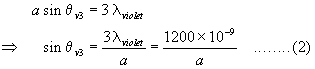
The angular position of the 3rd order violet
light is given by |
|
|
 |
1 |
|
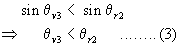
From (1) and (2), |
|
|
 |
1 |
|
Thus, part of the 2nd order spectrum exists
in the region of the 3rd order spectrum, i.e. overlapping of color occurs.
A pure spectrum for 2nd or higher order cannot be obtained. |
1 |
|
To produce a pure spectrum, we should use the
1st order of light from the diffraction grating. |
1 |