| a. |
Give
a brief account on the differences between light emitted from an ordinary
light bulb and light from a Laser. |
3
marks |
|
|
|
|
| Ordinary light |
Light from Laser |
| Consists of a range (spectrum) of color |
Monochromatic |
| Bursts of wave trains |
Continuous waveform |
| Short coherent length (sudden phase change within a wave
train of light) |
Coherent |
| Divergent |
Uni-directional |
| Weak |
Strong |
|
Any 3 |
|
|
|
| b. |
Discuss
how the wavelength of light from a sodium lamp could be measured from the
interference pattern produced by a Young’s double-slit. Discuss the conditions
for producing such an interference pattern. |
5
marks |
| |
|
|
|
 |
|
|
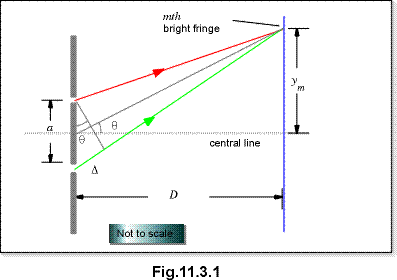
Light passing through the narrow slits at a small separation
a behaves like two coherent sources. |
|
|
The path difference for the two rays on reaching P
is |
|
|
 |
|
|
If the mth bright fringe occurs at P, then |
|
|
 |
|
|
The distance of P from the central maximum is |
|
|
 |
|
|
For small angle q, we have |
|
|
 |
|
|
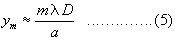
Therefore, |
|
|
 |
|
|
By knowing the values of m, D, a and
ym, the wavelength l could
be worked out. |
|
|
The conditions for obtaining an observable fringe pattern
with measurable fringe separation are |
|
|
-
The slit separation is small, for instance, in the order of the wavelength
of light
-
The slits are narrow so that light diffracts around the slit
|
|
| |
|
|
| c. |
Explain
the term “optical path”. Hence, discuss the effect on the interference
pattern produced by a Young’s double-slit if the whole arrangement is immersed
in water. |
4
marks |
| |
|
|
|
Optical path of light in a medium is the equivalent distance
travelled by light in vacuum. |
1 |
|
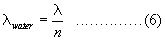
The wavelength of light in water is less than
that in vacuum. |
|
|
 |
1 |
|
where n is the refractive index of water. |
|
|
Thus, for a given physical length t
in water, the optical path is |
|
|
optical path = n
t |
|
|
When the set-up is immersed in water, the optical
path difference at the mth bright fringe is |
|
|
 |
1 |
|
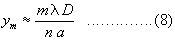
Thus, the position becomes |
|
|
 |
|
|
It is at a lower position than P. i.e.
the fringes are closer together. |
1 |
| |
|
|
| d. |
What
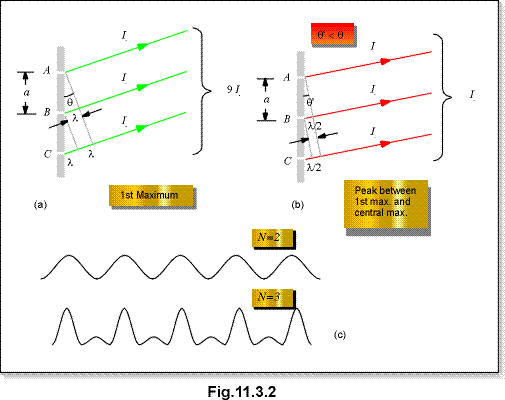
is the effect of adding more slits to a Young’s double-slit? Illustrate
your answer by referring to a 3-slit plate with uniform slit separation. |
4
marks |
| |
|
|
|
 |
2 |
|
When one more slit is added to a double-slit,
the positions of the maxima are unchanged. However, in between any two
maxima, a peak is formed. |
1 |
|
In Fig.b, light from A and B
are p out of phase and cancel out (destructive
interference). This leaves light from C alone. The intensity of
the peak is only 1/9th of that at the maxima. |
1 |
|
|
|