| a. |
What
is meant by the scattering of light? Briefly explain the blue color of
the sky at noon and its red color during sunset. |
5
marks |
|
|
|
|
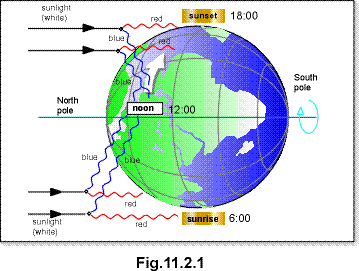
Scattering of light occurs when light energy
is absorbed by an atom or molecule, which then re-emits radiations in all
directions. |
1 |
|
The amount of scattering depends on the frequency
of light and the natural frequency of the atoms/molecules involved. |
|
|
Since the natural frequency of air molecules
lies in the ultra-violet region, blue light scatters more than red light
by the atmosphere. |
1 |
|
In sunset, light travels a longer distance
in atmosphere. Blue light is scattered to other regions of the Earth, leaving
behind red light. Thus, the sky is reddish. |
1 |
|
|
|
|
 |
2 |
|
|
|
| b. |
Describe,
giving explanation, one experiment for each of the following methods of
polarization of light:
i)
polarization by absorption |
7
marks |
| |
|
|
|
 |
1 |
|
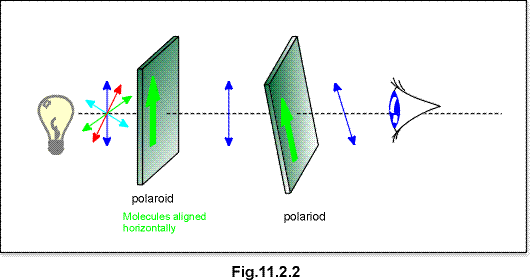
A polaroid consists of molecules which align in the same
direction. |
0.5 |
|
When an unpolarized light passes through, the electric
field of the light along the molecules is absorbed (energy is used to set
electrons to motion). |
0.5 |
|
As a result light passing through the polaroid is polarized.
It can be verified with another polaroid as shown in Fig.11.2.2. |
|
|
|
|
|
ii)
polarization by reflection |
|
| |
|
|
|
 |
1 |
|
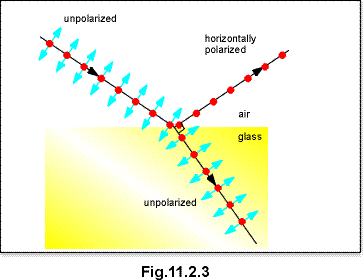
When light is reflected, molecules in the reflecting surface
re-emit the light. |
|
|
If the reflected beam is at right angle to
the refracted beam, the vertical electric field set the electrons to oscillate
along the reflected ray. |
0.5 |
|
Light intensity emitted along the motion of
electrons is zero. Thus, there is no vertical electric field along the
reflected ray. The reflected ray consists of only horizontal electric field,
i.e. the reflected ray is horizontally polarized. |
0.5 |
|
The angle at which the reflected ray and the
refracted ray are at right angle is called the Brewster's Angle. |
|
|
|
|
|
iii)
polarization by scattering. |
|
| |
|
|
|
 |
2 |
|
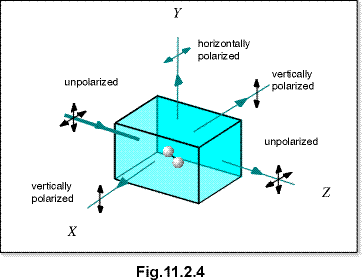
In scattering, the intensity of scattered light
is zero along the field lines of the incident light and is maximum at right
angles to the field lines. |
|
|
In this experiment, light is made to pass through
a tank of diluted "Dettol" solution. |
|
|
The scattered light along any direction at
right angle to the incident ray is plane polarized. |
1 |
|
|
|
| c. |
State,
and briefly explain, two daily applications of the polarization of light. |
4
marks |
| |
|
|
|
Applications of polarization
of light |
|
|
Liquid Crystal Display
(LCD) |
|
|
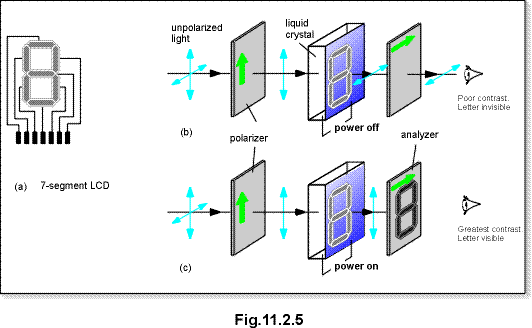
Without applied voltage, a liquid crystal rotates
the electric field of light through 90o. |
0.5 |
|
With an applied voltage, the molecules align
along the electric field and behaves like a polaroid. |
0.5 |
|
An LCD consists of two perpendicular polaroid
with a liquid crystal in-between. Without applied voltage, light can pass
through. With an applied voltage light is blocked in the area of the liquid
crystal. This area becomes dark and letters/numbers become visible. |
1 |
|
 |
1 |
|
Sunglass |
|
|
A sunglass is a polaroid. It could reduce the
intensity of unpolarized light by 50%. |
1 |
|
|
|