| a. |
Explain
briefly the Huygen’s method in constructing wavefronts. |
2
marks |
| |
|
|
|
Huygen's Principle |
|
|
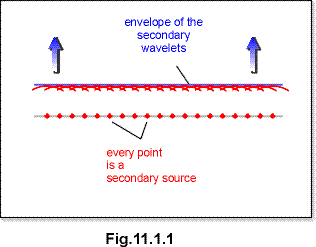
Every point on the wavefront may be regarded
as a source of secondary waves. The new wavefront is the envelope of these
secondary wavelets. |
1 |
|
 |
|
| |
|
|
| b. |
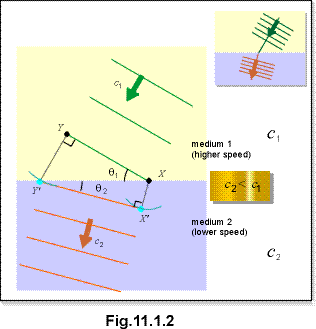
The
absolute refractive index of a medium is defined as the ratio of the speed
of light in free space to the speed of light in the medium. Consider a
beam of light passing obliquely from one medium to the other. Using Huygen’s
principle, obtain an expression for the ratio of the sine of the angles
that the wavefronts make with the boundary in terms of the refractive indices
of the media. |
4
marks |
| |
|
|
|
 |
1 |
|
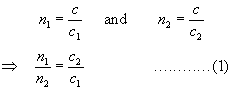
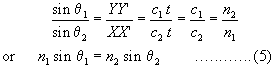
Suppose the speed of light in vacuum is c.
The refractive indices of medium 1 and 2 are, respectively, |
|
|
 |
1 |
|
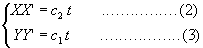
Suppose it takes time t for XY to reach X'Y' in
Fig.11.1.2. We have |
|
|
 |
1 |
|
Let q1 and q2
be the angles that XY and X'Y' make with the boundary. |
|
|
 |
|
|
Thus, |
|
|
 |
1 |
| |
|
|
| c. |
A
parallel beam of monochromatic light is directed at a diffraction grating
along its axis. Using Huygen’s principle, describe and explain the the
interference pattern as viewed from the other side of the grating. Obtain
an expression for the spatial positions of the bright fringes. |
6
marks |
| |
|
|
|
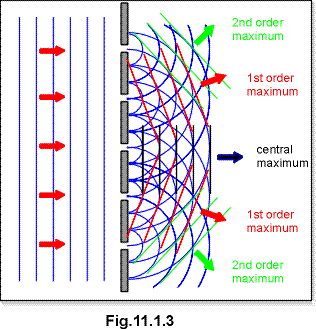
A diffraction grating consists of many equidistant parallel
lines. When it is illuminated with parallel light, it may be regarded as
a set of many coherent sources of secondary wavelets. |
1 |
|
 |
3 |
|
According to Huygen's principle, the light
coming out is only the envelopes of these secondary wavelets. From the
diagram above, only a few wavefronts could be drawn. This explains the
interference pattern of a grating, in which several orders of light is
visible. |
2 |
| |
|
|
| d. |
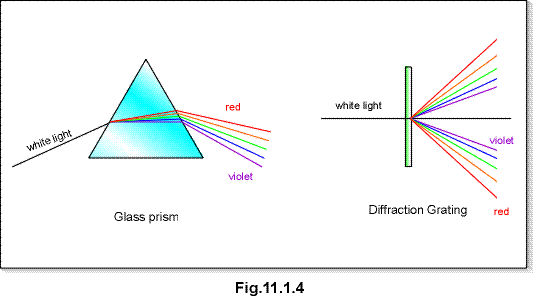
With
the aids of diagrams, compare the color spectra produced by
i)
dispersion of sunlight using a glass prism and |
4
marks |
|
ii)
superposition of sunlight using a diffraction grating. |
|
| |
|
|
|
 |
2 |
|
Dispersion |
|
|
Violet light has a greater refractive index
than red light. Thus, violet are bent more by the glass prism than red. |
1 |
|
Diffraction grating |
|
|
Diffraction depends on the wavelength. The
longer wavelength diffracts more. Red is longer in wavelength than violet.
Thus, red is found to diffract through a larger angle. |
1 |
|
|
|