| a. |
Explain
the following arrangements of loudspeakers:
i)
loudspeakers of various sizes are used in Hi-Fi systems |
4
marks |
| |
|
|
|
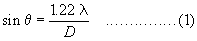
Diffraction of sound depends on the relative
size of the source aperture and the wavelength, according to |
1 |
|
 |
|
|
In a Hi-Fi system, sounds of various frequencies
are generated. A sound of lower frequency has a longer wavelength and diffracts
more. |
|
|
A sound of higher frequency has a shorter wavelength
and diffract less. |
1 |
|
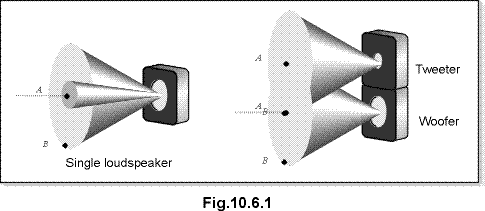
If a single loudspeaker is used, the spreads
of sound are not the same for high pitch as low pitch. |
|
|
To solve the problem, higher pitch sounds are
directed to smaller loudspeakers, so that their spread is as large as the
lower pitch sound. |
0.5 |
|
 |
0.5 |
|
|
|
|
ii)
loudspeakers in halls are arranged in vertical columns. |
|
| |
|
|
|
When the speakers are arranged in vertical columns, each
column behaves like a vertical slit-source of waves. |
|
|
Since the height of the source is much greater than than
the wavelength of sound, there is relatively little diffraction in the
vertical direction. Thus, there is little loss to the ceiling and the floor. |
|
|
Because of the narrow width, diffraction sideways is significant.
Thus, sound spreads evenly in the horizontal direction. |
1 |
| |
|
|
| b. |
Illustrate
the major principles for the causes of the following wave phenomena:
i)
beats |
7
marks |
| |
|
|
|
Beats are caused by the superposition of two similar waves
of slightly different frequencies. The resultant wave has a periodic change
in amplitude whose frequency is much less than the original waves, namely,
fbeat = f1 - f2. |
|
|
An application of beat is in tuning of musical
instruments by standard tuning forks. |
|
| |
|
|
|
ii)
stationary waves |
|
| |
|
|
|
Stationary waves are confined in fixed boundaries
in which superposition occurs for an incident waves with its reflection.
Nodes and antinodes can be found in certain positions of a stationary wave. |
|
|
An application of stationary wave is sound
production by musical instrument. |
|
| |
|
|
|
iii)
interference.
Give an application
for each of the above wave phenomena. |
|
| |
|
|
|
Interference occurs when two waves of the same
frequency and amplitude, but different path lengths, meet with each other.
Since there is phase difference, the result of superposition may be constructive
or destructive. Thus, the resulting pattern has an uneven distribution
of wave energy, i.e. positions of maximum and minimum. |
|
|
An application of interference is the determination
of wavelength. |
|
| |
|
|
| c. |
Describe
an experiment to measure the speed of sound using an air column of variable
length and a tuning fork of known frequency. |
5
marks |
| |
|
|
|
 |
1 |
|
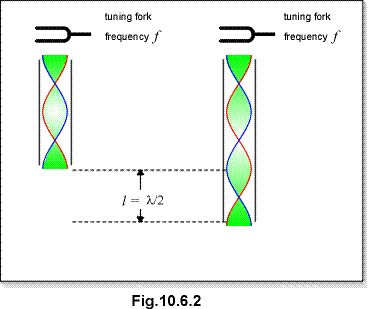
Place a vibrating tuning fork near one end
of the open pipe. Adjust the length of the tube until a resonance occurs
(with a loud sound). |
1 |
|
Mark the length of the tube. |
|
|
Increase the length again until another resonance
occurs, i.e. another stationary wave within one loop more than before is
formed. |
1 |
|
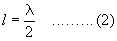
Since the length of one loop in a stationary
wave is half the wavelength, we have |
|
|
 |
1 |
|
Knowing the frequency of the tuning fork, the
speed of sound is |
|
|
 |
1 |
|
|
|