| a. |
Sketch
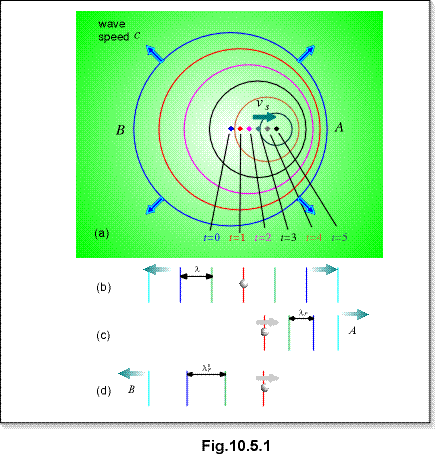
the waveform around a moving object which emits sound waves at a constant
frequency. Hence, derive expressions for the frequency of sound heard by
observers
i)
in front of the moving source |
6
marks |
| |
|
|
|
 |
2 |
|
Suppose A is the receiver in front of the moving
source, which has speed vs. In each second, f
complete waves a generated. However, these waves occupy a distance of only
(c - vs). |
|
|
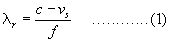
The apparent wavelength of sound heard by A
is |
|
|
 |
|
|
The apparent frequency of sound heard by A
is |
|
|
 |
|
|
It is higher than f. |
|
| |
|
|
|
ii)
behind the moving source. |
|
| |
|
|
|
Suppose B is the receiver behind the source, which moves
away with speed vs. In each second, f complete
waves a generated. These waves occupy a distance of (c
+ vs). |
|
|
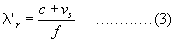
The apparent wavelength of sound heard by B is |
|
|
 |
|
|
The apparent frequency of sound heard by B is |
|
|
 |
|
| |
It is lower than f. |
|
| |
|
|
| b. |
What
is the meaning of red-shift? Explain the following astronomical phenomena:
i)
the red-shift of spectrum from a star |
4
marks |
| |
|
|
|
Red shift refers to the apparent overall increase in wavelength
of light in an absorption spectrum as a result of Doppler Effect, i.e.
a shift of visible light towards the red side which has a longer wavelength. |
1 |
|
Red-shift of spectrum
from a star |
|
|
Astronomical results show that light from all
stars has a longer wavelength than the same source in an Earth-bound laboratory. |
|
|
According to Doppler effect, the increase in
wavelength is caused by the receding motion of stars. Thus, all stars are
moving away from the Earth. |
1 |
| |
|
|
|
ii)
broadening of the line spectrum from the Sun. |
|
| |
|
|
|
Radiation from the Sun is emitted from excited
gas molecules. Since the surface temperature of the Sun is very high, gas
molecules are moving away and towards the Earth at very high speed. |
1 |
|
According to Doppler effect, the wavelength
of light due to receding molecules is lengthened; that due to approaching
molecules is shortened. Thus, the spectral line is broadened. |
1 |
| |
|
|
| c. |
Write
down the expression for the change in frequency of electromagnetic waves
when the transmitter and the receiver are moving towards each other at
relative speed v. No mathematical derivation is required. Hence, explain
in details how the speeds of vehicles in highways could be measured using
the Doppler Effect. |
6
marks |
| |
|
|
|
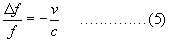
When the transmitter and the receiver move
towards each other the frequency of waves received is decreased. The change
in frequency Df is given by |
|
|
 |
|
|
where c is the speed of light. |
1 |
|
 |
1 |
|
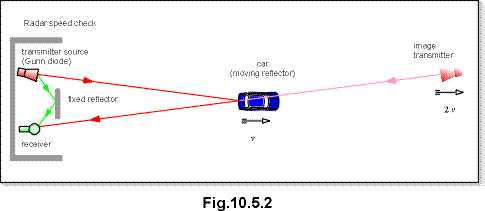
In highway speed check, the transmitter emits
a pulse of EM waves towards a vehicle. The vehicle reflects the pulse.
It acts as a moving reflector. Thus, to any stationary observer, the pulse
(reflected) seems to be emitted from a transmitter moving at a speed of
2v. |
1 |
|
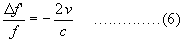
Thus, the change in frequency Df'
is given by |
|
|
 |
1 |
|
The detector receives both the pulse directly
reflected by a fixed reflector (no change in frequency) and the pulse reflected
by a moving vehicle (with change in frequency). |
1 |
|
Since the two pulses are of slightly different
frequencies, beats occur when they merge together. Find the beat, the change
in frequency can be worked out. Therefore, the speed of vehicle is measured. |
1 |
|
|
|