| a. |
With
the aid of a diagram, explain how a standing wave is formed inside a closed
tube. |
4
marks |
| |
|
|
|
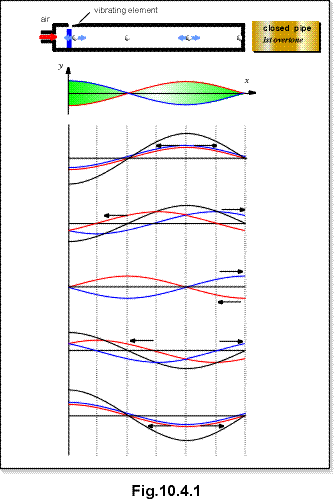
Standing wave in a closed tube is caused by
the superposition of the incident waves and the reflected waves by the
closed end and the open end. |
1 |
|
Reflection at the closed end undergoes a p
phase change. Thus, a node occurs. |
|
|
Reflection at the open end does not have phase
change. Thus, an anti-node occurs. |
1 |
|
|
|
|
 |
2 |
| |
|
|
| b. |
Describe
an experiment to measure the speed of sound in air using a closed tube. |
4
marks |
| |
|
|
|
 |
1 |
|
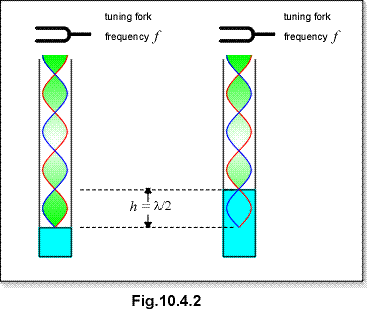
Erect the closed tube vertically with the open end above. |
|
|
Place a tuning fork of known frequency f above the
open end. Add water until resonance occurs (a loud sound is heard). |
0.5 |
|
Mark the height of water. Then add water slowly until another
resonance occurs. |
0.5 |
|
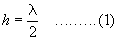
The difference in position h of water level is one
loop i.e. half wavelength. |
|
|
 |
1 |
|
The speed of sound in air is given by |
|
|
 |
1 |
| |
|
|
| c. |
State
and explain the conditions for sound waves travelling between air and water
to undergo total internal reflection. |
3
marks |
| |
|
|
|
Sound waves travel more slowly in air than in water. Thus,
when it enters into water it will bend away from the normal. |
1 |
|
In particular, when the angle of incidence is equal to
the critical angle, the angle of refraction is 90o. |
|
|
When the angle of incidence is greater than the critical
angle, total internal reflection of sound occurs. |
1 |
|
 |
1 |
| |
|
|
| d. |
Describe
an experiment to measure the speed of sound in copper using a copper rod
of length about 1 m. Explain why a timing device with a precision of 1
ms is not appropriate to give an accurate result. |
5
marks |
| |
|
|
|
 |
1 |
|
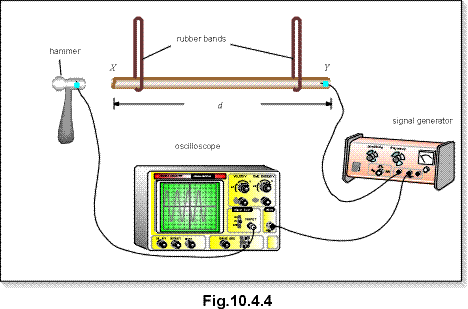
Suspend a copper rod XY of length d horizontally
by two rubber bands. Connect the rod to a signal generator through an oscilloscope
and a hammer as shown. |
|
|
As the copper rod is given a sharp tap with
the hammer, a compression pulse travels from X and is reflected at Y as
a rarefaction pulse. |
1 |
|
The hammer remains in contact with the rod
while the pulse travels from X to Y and then back to X again, i.e. a distance
of 2d. |
|
|
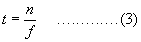
The time of contact t is determined
by the frequency setting f of the signal generator. If n
complete cycles occurs on the CRO screen, then |
1 |
|
 |
|
|
The speed of sound in copper is given by |
|
|
 |
1 |
|
The speed of sound in copper is about 5000
m s-1. Thus, the time of contact is about |
|
|
 |
1 |
|
Thus, it is impossible to measure the time
required using a timing device with precision less than 1 ms. |
|