| a. |
With
reference to the sound produced by a loudspeaker, explain why the frequency
of the emitted sound waves is the same as the frequency of the vibrating
source. |
3
marks |
| |
|
|
|
 |
1 |
|
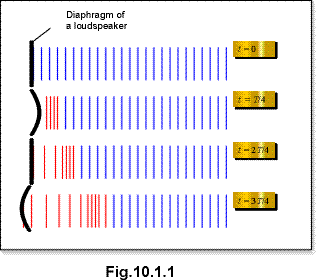
When the diaphragm of the loudspeaker moves
to the right, a compression is produced. When it moves to the left, a rarefaction
is produced. |
1 |
|
A complete sound wave (consisting of a compression
and a rarefaction) is generated when the diaphragm moves to-and-fro in
one complete cycle. Thus, the frequency of sound is equal to the frequency
of the diaphragm. |
1 |
| |
|
|
| b. |
What
is an “ultrasound”? Give a brief account on the medical diagnosis using
ultrasonic imaging. Compare this with X-ray imaging. |
4
marks |
| |
|
|
|
Ultrasounds are sound waves that have a frequency higher
than 20 kHz. |
1 |
|
In ultrasonic imaging, the ultrasound transducer is placed
on the surface of the patient, with a thin layer of liquid in between. |
0.5 |
|
Pulses of ultrasound are emitted and penetrate into the
body. They are reflected from different depths within the body. A computer
converts the reflected signals into a picture that displays the internal
organs for diagnosis. |
0.5 |
|
In X-ray diagnosis, the detector is located on the opposite
side as the transmitter to detect the transmitted signal; while in ultrasound
imaging, the reflected signal is detected. |
0.5 |
|
X-rays are high energy radiations and are harmful to human
body. Ultrasounds are harmless. |
0.5 |
|
The penetration power of X-rays is much higher than ultrasound.
They are absorbed by high density material. Thus, X-rays are good for revealing
bone fractures but cannot be used to detect tissue organs. |
1 |
| |
|
|
| c. |
With
the help of a diagram, give a brief account on how ultrasound can be used
to detect flaws in materials. |
4
marks |
| |
|
|
|
 |
1 |
|
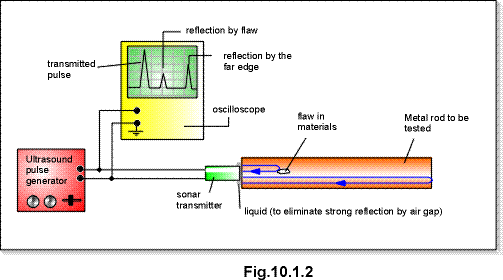
A sonar transmitter and detector is placed
in contact with one end of the material. |
0.5 |
|
A sharp pulse of ultrasound is sent toward
the material. |
0.5 |
|
If the material is perfect, the video screen
will show two pulses, one due to the transmitted pulse, the other due to
the reflection at the far end. |
1 |
|
If there is a flaw in the material, the flaw
will reflect partially. Thus, the video screen will give more than two
pulse as shown. |
1 |
| |
|
|
| d. |
Explain
the meaning of “loudness”. Give three physiological factors that may affect
the perception of intensity of sound. |
5
marks |
| |
|
|
|
Loudness
is the physiological perception of sound intensity. It is a sensation of
the human ear, varying from one person to another. |
1 |
|
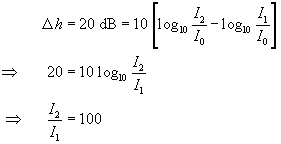
Our ear responds logarithmically to the intensity.
If the sound intensity level increases by 20 dB, the new sound seems approximately
twice as loud as the original sound. |
1 |
|
An increase in 20 dB is in fact an increase
of intensity by hundred (100 = 102) times. |
0.5 |
|
 |
0.5 |
|
Our hearing system responds differently to
different frequencies. We are more sensitive to sound with frequencies
1 kHz to 5 kHz. |
1 |
|
Another factors is the duration. Long bursts
of sound are louder than the short bursts. |
1 |