| a. |
State
and explain the differences between a progressive and a stationary waves. |
3
marks |
| |
|
|
|
In a progressive wave, energy is transmitted
from the source to places around it without return. In a stationary wave,
energy is localized. |
1 |
|
A progressive wave advances with the velocity
of the wave, while the waveform of a stationary wave is confined within
some boundaries where reflections of waves occur. |
1 |
|
A progressive wave can take up virtually any
frequency. An observable stationary wave pattern occurs with specific frequencies
only, namely, multiple of the fundamental frequency. |
1 |
| |
|
|
| b. |
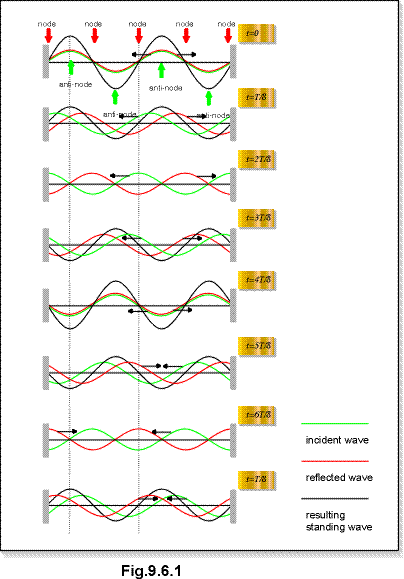
Explain
briefly why nodes and antinodes of displacement are formed in a stationary
wave. You should sketch the superposed components in each 1/8th of a cycle. |
6
marks |
| |
|
|
|
 |
|
|
Standing wave is caused by the superposition of the incident
wave and the reflected wave. |
|
|
In the diagram above, the reflection on the right side
undergoes p phase change. As a result, the displacement
at the fixed end for the two components are opposite and a node always
occurs there. |
|
| |
|
|
| c. |
Discuss
the difference between echo and stationary waves, explaining the general
circumstances in which each is produced. |
3
marks |
| |
|
|
|
An echo is the reflection of a pulse of sound.
A large reflector at a considerable distance is required. It occurs with
a time delay that depends on the distance between the source and the reflector. |
1 |
|
Unlike a standing wave, there is no superposition
for an echo between the transmitted wave and the reflected wave. |
1 |
|
A standing wave requires fixed boundaries and
a source that generates waves at some specific frequencies. When the frequency
matches with the required values, positions of node and antinode would
be formed. |
1 |
| |
|
|
| d. |
Devise
an experiment to set up a stationary wave from a microwave transmitter.
Suggest how you can determine the wavelength of the microwaves from your
experimental set-up. |
4
marks |
| |
|
|
|
Set-up for a standing
microwave |
|
|
 |
1 |
|
Place a metal reflector in about half a metre
from a microwave transmitter. |
0.5 |
|
A microwave detector probe is moved along the
line between the reflector and the transmitter. |
0.5 |
|
Adjust the relative position of the reflector
and the transmitter until a zero reading is detected. If a zero reading
cannot be obtained, the probe may need to be re-positioned. |
0.5 |
|
When a node is detected, marked the position
of the the probe. Move the probe so that its reading rises and then falls
to zero again. |
0.5 |
|
The distance d moved by the probe is
half the wavelength of the microwave. |
|
|
Thus, the wavelength is |
|
|
 |
1 |
|
|
|