| a. |
Discuss
how the phase relationship between two electrical signals is determined
by using a double beam oscilloscope. |
3
marks |
| |
|
|
|
 |
|
|
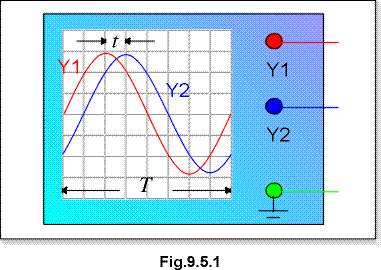
Two signals of the same frequency and a constant
phase difference are fed to the CRO at the inputs Y1 and Y2 with common
earth. |
|
|
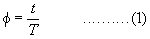
From the display, the separation t between
the two crests is measured. The horizontal extent T for a complete
wave is also measured. The phase difference is given by |
|
|
 |
|
|
The horizontal axis on the screen is similar
to time axis since the waveforms on a CRO are always displayed from left
to right. For two adjacent crests, the crest on the left leads the crest
on the right. |
|
|
|
|
| b. |
Devise
an experiment to show how the phase of vibration of air molecules varies
with position along the direction of propagation of a sound wave. Hence,
discuss how you can determine the speed of sound using the same set up. |
4
marks |
| |
|
|
|
 |
1 |
|
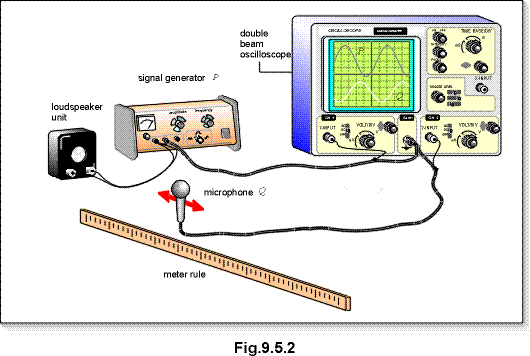
In this experiment, the CRO receives and displays both
the signals from the signal generator and the microphone. As the microphone
is moved along the metre rule, the waveform Q shifts, revealing a change
in phase difference between the two signals. |
1 |
|
If the microphone moves through a distance such that the
phase difference between the signals P and Q resumes it old value, the
distance moved by the microphone is exactly one wavelength l. |
1 |
|
Knowing the frequency of the sound waves (which is the
frequency of the signal generator), the wave speed is |
|
|
 |
1 |
|
|
|
| c. |
State
and explain how you can use a stroboscope to determine the frequency of
water waves in a ripple tank. Discuss how the viewed pattern of the water
waves changes if the rotational speed of the stroboscope that freeze the
pattern is slightly increased or decreased. |
5
marks |
| |
|
|
|
A stroboscope can freeze the waves in a ripple
tank when the strobe frequency is a fraction of the wave frequency or a
multiple of the wave frequency. |
1 |
|
However, if the strobe frequency is higher
than the wave frequency, the frozen pattern has a reduction in wavelength. |
1 |
|
Thus, if the stroboscope is rotated at the
maximum speed and freezes the wave pattern without any apparent reduction
in wavelength, then the wave frequency is equal to the strobe frequency. |
1 |
|
If the strobe frequency is increased slightly,
the wave has not completed one cycle. Thus, the viewed pattern seems to
move backward (towards the source.) |
1 |
|
If the strobe frequency is decreased slightly,
the wave has completed slightly more than one cycle. Thus, the viewed pattern
seems to move forward. |
1 |
| |
|
|
| d. |
What
is meant by the refraction of waves? Discuss how the Snell’s Law can be
verified using the theory in wave. |
4
marks |
| |
|
|
|
Refraction of
waves is the change in direction of propagation as the waves move obliquely
across the interface between two medium, which is accompanied with a change
in wave speed. |
1 |
|
Snell's Law |
|
|
 |
1 |
|
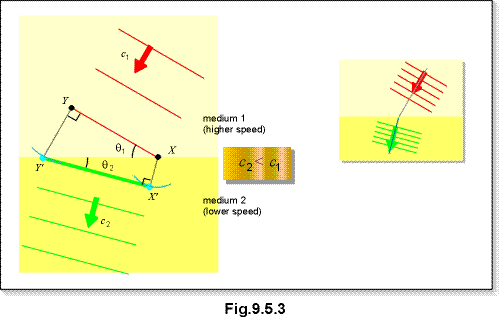
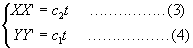
Suppose it takes time t for XY to reach
X'Y' and the wave velocities in medium 1 and medium 2 are c1
and c2 respectively. We have |
|
|
 |
|
|
Let q1
and q2 be the angles that XY and
X'Y' make with the boundary respectively. From the diagram, |
|
|
 |
1 |
|
Thus, |
|
|
 |
1 |