| a. |
State
the principle of superposition for waves. Explain how you would demonstrate
the principle using a slinky spring. |
3
marks |
| |
|
|
|
Principle of superposition |
|
|
When two or more waves meet at a point, the
total displacement is equal to the algebraic sum of the individual displacement
at that point. |
1 |
|
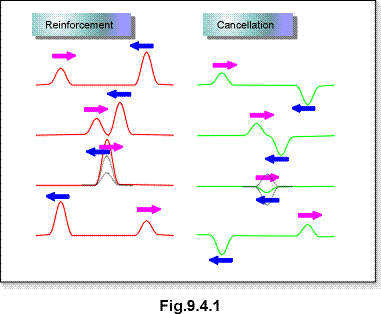
To demonstrate the principle |
|
|
 |
1 |
|
Send pulses of waves simultaneously from both
end towards each other. |
|
|
If the pulses have the same direction of displacement,
the resultant at the point when they meet is a reinforcement. This is known
as constructive interference. |
0.5 |
|
If the pulses have opposite directions of displacement,
the resultant at the point when they meet is a cancellation. This is known
as destructive interference. |
0.5 |
| |
|
|
| b. |
Explain
what is meant by coherent sources and why the term coherence is meaningless
for two sources with different frequencies. |
3
marks |
| |
|
|
|
Two sources are coherent if they have a constant phase
difference. |
1 |
|
Thus, the time interval between the occurrence of crest
in two waves is unchanged. |
1 |
|
If the two sources have different frequencies, the time
interval between the occurrence of crest in the two waves is never fixed. |
1 |
| |
|
|
| c. |
Using
the principle of superposition, explain the formation of beats, with the
aid of a diagram. Derive an expression relating the beat frequency to the
frequencies of the two superposing waves. |
6
marks |
| |
|
|
|
 |
2 |
|
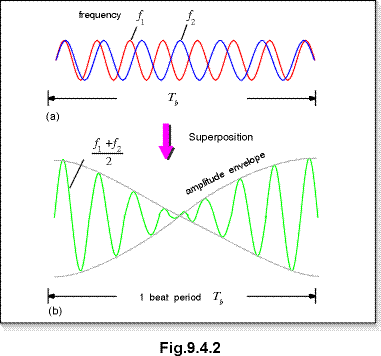
When two waves of slightly different frequencies
superimpose, the resultant wave have a varying amplitude. This is known
as beat. |
1 |
|
The diagram shows the superposition of two
waves with frequency f1 and f2. One
wave produces exactly one more cycle than the other. |
0.5 |
|
Suppose the time for generating these waves
is Tb. We have |
|
|
 |
1 |
|
The superposed displacement in (b) shows that
a minimum occurs between two maxima. i.e. One beat occurs in time Tb. |
0.5 |
|
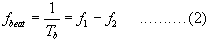
The beat frequency is |
|
|
 |
1 |
|
Thus, the beat frequency is the difference
in frequency between the two waves. |
|
| |
|
|
| d. |
State
and explain the differences between an interference pattern and beats.
Give an application for each of them. |
4
marks |
| |
|
|
|
Interference pattern is produced by two sources
with exactly the same frequency. The path difference between the two waves
at a point determines the result of superposition at that point. Intensity
varies from one position to another. However, the resulting wave has the
same frequency as either source. |
|
|
An application of interference is to determine
the wavelength. |
|
|
Beat occurs when two sources emit waves with
slightly different frequencies. The amplitude of the resultant wave varies
with time and the frequency is the average of the two sources. The rate
at which the wave intensity changes is independent of the position of the
receiver but depends on the difference in frequencies. |
|
|
An application of beat is in tuning musical
instrument, like a piano. |
|
|
|
|