| a. |
Give
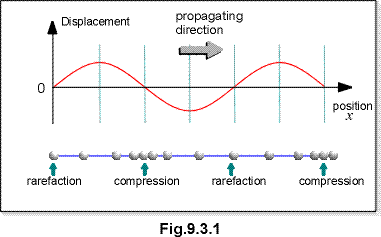
a brief account on the propagation of sound wave through the air. Draw
suitable graphs to illustrate and compare the variation of
i)
the displacement of air particles with position along the direction of
propagation. |
5
marks |
| |
|
|
|
Sound is a longitudinal wave. A series of compression
and rarefaction moves along the direction of the wave. |
1 |
|
Air particles vibrate along the direction of
propagation. Take the displacement along the direction of propagation to
be positive and otherwise negative. |
|
|
 |
1 |
| |
|
|
|
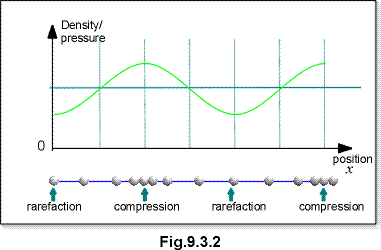
ii)
the pressure changes with position along the direction of propagation. |
|
| |
|
|
|
The pressure is highest at the position of compression
and lowest at the position of rarefaction. |
|
|
 |
1 |
| |
|
|
|
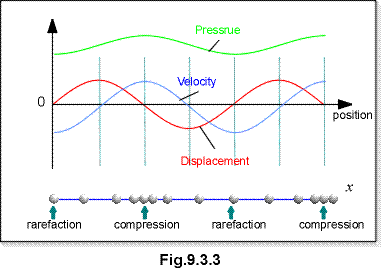
iii)
the velocity of air particles with position along the direction of propagation. |
|
| |
|
|
|
 |
2 |
| |
|
|
| b. |
Compare
the modes of propagation of the waves along a long thick copper rod, produced
by tapping one end and the waves along a tightened thin copper wire, produced
by striking it at the middle. |
3
marks |
| |
|
|
|
When a rod is tapped at one end, a compression
pulse is sent along the length of the rod. The wave produced is longitudinal.
Vibration of particles in the rod is along the direction of propagation. |
1 |
|
When a wire is plucked at the middle, a standing
transverse wave would be produced. The particles are vibrating up and down
at right angles to the direction of the wave.. |
2 |
| |
|
|
| c. |
Explain
carefully what is meant by resonance and give two specific examples of
its occurrence. |
4
marks |
| |
|
|
|
Every object has its own natural frequency.
If an object is forced to oscillate, the amplitude of oscillation depends
on the driving frequency. In particular, largest amplitude occurs when
the driving frequency is equal to the natural frequency. Resonance is said
to occur. |
|
|
|
|
|
Examples of resonance are |
|
|
-
musical instrument
-
tunning circuit
-
absorption spectrum
|
|
| |
|
|
| d. |
There
are several ways in which a metre rule, clamped at one end, may vibrate.
Each of these ways is associated with a resonant frequency. Draw sketches
to illustrate the two lowest resonant modes for the rule and explain how
the rule could be induced to vibrate in these modes. |
4
marks |
| |
|
|
|
 |
2 |
|
The two lowest resonant modes, fundamental
and 1st overtone, are shown above. |
1 |
|
The fundamental mode can be set easily by plucking
at the free end. |
|
|
To set the 1st overtone, slightly hold at one-third
distance from the free end and pluck at one-third distance from the fixed
end. |
1 |
|
|
|