| a. |
A
continuous transverse wave is sent along a heavy spring without any reflection.
Show that the power of the wave received by the target is proportional
to
i)
the square of the amplitude |
5
marks |
|
ii)
the square of the wave frequency |
|
| |
|
|
|
 |
1 |
|
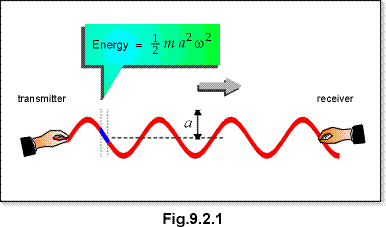
Suppose a transverse wave of amplitude a is sent
along a string. |
|
|
The particles in a travelling wave are performing SHM.
Consider a small section (blue color in Fig.9.2.1) of mass m. The
energy carried by m is |
1 |
|
 |
1 |
|
Suppose the mass per unit length of the string is m.
Then, each wavelength of the string will carry energy of |
|
|
 |
1 |
|
This amount of energy will be received by the receiver
within one period. Thus, the power of the wave is |
|
|
 |
1 |
|
Thus, the power is proportional to the square of amplitude
and the square of the frequency. |
|
| |
|
|
| b. |
Explain
the meaning of wave intensity. Discuss how the wave intensity received
by a receiver varies with the distance from a wave source. You should discuss
separately
i)
a point source emitting spherical waves |
4
marks |
| |
|
|
|
Intensity
I is defined as the power received per unit area. |
|
|
Point source |
|
|
 |
|
|
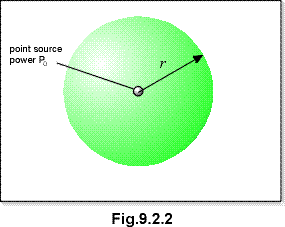
Suppose the power of the point source is Po.
Assuming no energy loss, the power would be distributed evenly over a spherical
area of 4 p r2. |
|
|
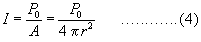
Thus, the intensity of wave at distance r
from the source is |
|
|
 |
|
|
Since
 |
|
|
the amplitude varies with r as follows: |
|
|
 |
|
| |
|
|
|
ii)
a line source emitting cylindrical waves.
Hence, find the relationship between the wave amplitude and the distance
from the source. |
|
| |
|
|
|
Line source |
|
|
Suppose the power of the line source is Po.
Assuming no energy loss, the power would be distributed evenly over the
curved area of the cylinder: 2 p r h. |
|
|
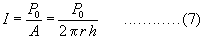
Thus, the intensity of wave at distance r
from the source is |
|
|
 |
|
|
The amplitude varies with r as follows: |
|
|
 |
|
| |
|
|
| c. |
A
pulse of longitudinal wave is sent along a horizontal slinky spring, with
a compression followed by a rarefaction. Using a diagram, describe the
reflected pulse if the other end of the slinky is
i)
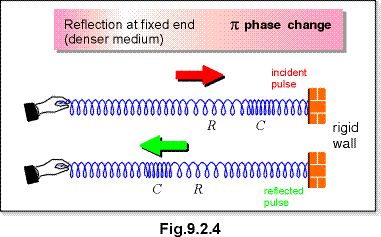
a fixed wall |
3
marks |
| |
|
|
|
 |
1 |
|
The wave reflected at a denser medium undergoes
p phase change. Thus, the initial motion to
the right becomes left motion after reflection. |
0.5 |
| |
|
|
|
ii)
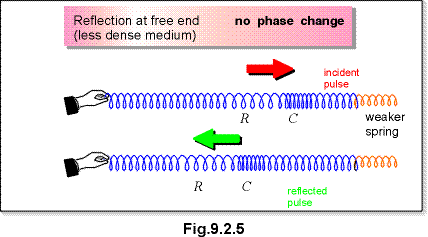
another horizontal slinky with a smaller spring constant. |
|
| |
|
|
|
 |
1 |
|
A spring with a smaller spring constant is
a weaker spring. Thus, the wave is reflected at a less dense medium. There
is no phase change. |
0.5 |
| |
|
|
| d. |
A
ball falling vertically is rebound from a horizontal ground. Show that
the time of contact during the impact is dependent on the size and the
material of the ball. |
4
marks |
| |
|
|
|
 |
1 |
|
When the ball hits the ground, a compression
pulse is generated and propagates upward until it reaches the top of the
ball. |
1 |
|
As the pulse is reflected by a less dense medium,
there is no phase change and the compression pulse becomes a rarefaction. |
1 |
|
The ball remains in contact with the ground
until the reflected pulse reaches the bottom. |
|
|
The time of contact is equal to the time for
the pulse to travel inside the ball for a distance equal to twice the diameter.
It is dependent on the size of the ball. The speed of travel depends on
the material of the ball. |
1 |