| a. |
State
the Huygen’s principle and explain how new wavefronts could be constructed
for water waves that undergo
i)
reflection |
6
marks |
| |
|
|
|
Huygen's Principle |
|
|
Every point on the wavefront may be regarded
as a source of secondary waves. The new wavefront is the envelope of these
secondary wavelets. |
1 |
|
Reflection |
|
|
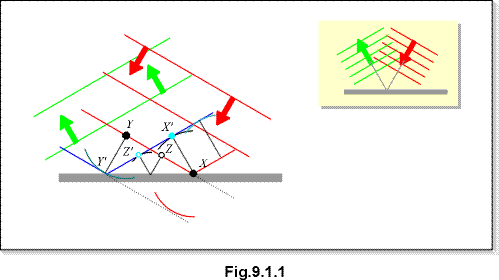 |
1 |
|
After one period, X becomes X', Y becomes Y'
and Z becomes Z'. The wavefront consisting X', Y' and Z' represents the
reflected wavefront. |
|
|
|
|
|
ii)
refraction |
|
| |
|
|
|
Refraction |
|
|
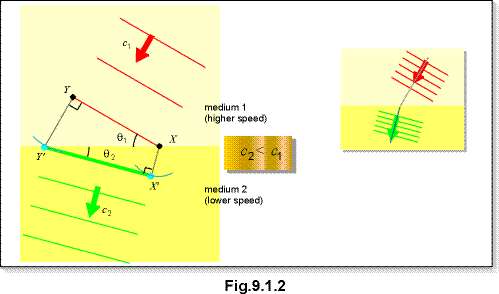 |
1 |
|
After one period, X becomes X' and Y becomes Y'. It is
clear that XX' < YY'. Thus, the direction of propagation bends as the
wave enters medium 2. |
0.5 |
| |
|
|
|
iii)
total internal reflection. |
|
| |
|
|
|
Total internal reflection |
|
|
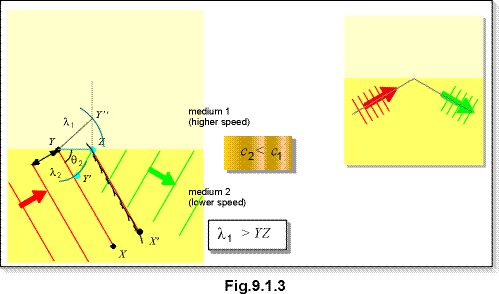 |
1 |
|
Consider the wavefront XY. After one period,
X becomes X'. If the wave refracts, then Y becomes Y''. However, YY'' is
greater than YZ. i.e. l1 > YZ. It
is impossible to construct a continuous wavefront with wavelets in medium
1. |
0.5 |
|
Thus, refraction is impossible. |
|
|
If reflection occurs, Y becomes Y'. This is
possible. Thus, the wave undergoes total internal reflection and propagates
in medium 2. |
0.5 |
| |
|
|
| b. |
Sketch
a diagram to show how a pulse of a transverse wave is reflected by
i)
a denser medium |
3
marks |
| |
|
|
|
 |
1 |
|
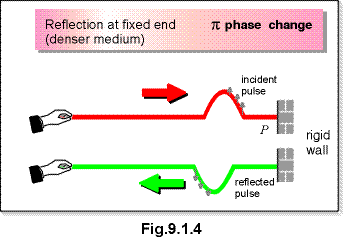
The wave reflected at a denser medium undergoes
p phase change. Thus, the initial upward motion
becomes downward motion after reflection. |
0.5 |
| |
|
|
|
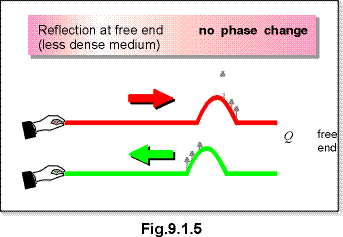
ii)
a rarer medium. |
|
| |
|
|
|
 |
1 |
|
The wave reflected at a less dense medium does
not undergoes any phase change. Thus, the initial upward motion remains
as upward motion after reflection. |
0.5 |
| |
|
|
| c. |
Compare
the two ranging methods: RADAR and SONAR, in terms of their areas of applications. |
3
marks |
| |
|
|
|
Both RADAR and SONAR make use of reflection
of waves by a distant object. |
0.5 |
|
RADAR emits a pulse of microwaves while SONAR
emits a pulse of ultrasound (sound wave of high frequency). |
1 |
|
The penetration power of microwaves in air
is much better than sound. Thus, it is commonly used in air-traffic control,
missile early warning and ship navigation systems. |
0.5 |
|
RADAR is never used underwater because microwaves
is easily absorbed by water. |
|
|
Sound, being a mechanical waves consisting
of a series of compression and rarefaction, can travel efficiently in water
and other medium like iron bar. |
0.5 |
|
Thus, SONAR is commonly used in fishing to
spot shoals of fish, marine research and seabed mapping. It can also be
used to detect flaws in a piece of metal. |
0.5 |
|
|
|
| d. |
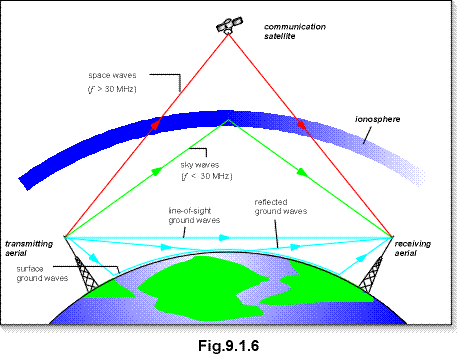
With
the aid of a diagram, discuss how radio waves could be transmitted across
different countries. In each method, explain clearly how the radio waves
are relayed to the receivers. |
4
marks |
| |
|
|
|
The two commonly used methods to transmit radio
waves across different countries are: |
|
|
-
Reflection by ionosphere
The Earth's atmosphere has a thin layer in which many atoms exist in
the form of ion-pairs. This layer could reflect radiation below 30 MHz.
However, the amount of ion pairs in this layer is unstable and absorption
occurs during the reflection. Thus, the reception is poor and unreliable.
-
Relayed by satellite
Microwaves are used because they can penetrate through the atmosphere
and reach the satellites orbiting round the Earth. The signals picked up
by the satellites are analyzed and amplified before they are re-emitted.
|
1.5
1.5 |
|
 |
1 |