| a. |
With
the aid of a sketched diagram. Explain the operating principle of
i)
a refrigerator |
6
marks |
|
|
|
|
 |
1 |
|
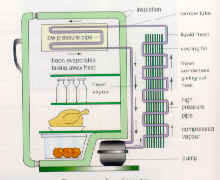
A refrigerator consists of pipes of varying
cross-sectional area and enclosing a volatile liquid called Freon. |
0.5 |
|
When the liquid passes through the wide tube,
pressure decreases and the Freon vaporizes. This requires latent heat of
vaporization and it is taken from the food inside. Thus, temperature falls. |
1 |
|
The pressure of the Freon is then increased
by a compressor. It liquefies. Heat is released by delivering heat to the
surrounding air through the fins at the back. |
0.5 |
|
|
|
|
ii)
a dehumidifier. |
|
|
|
|
|
 |
1 |
|
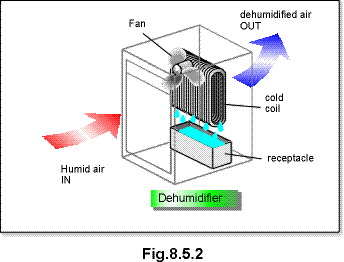
A dehumidifier works on the principle that if temperature
falls suddenly, a certain portion of water vapor in air would condense
in the form of liquid drops (dew or fog). |
1 |
|
It consists of a fan that draws humid air from the room
into the cold coils inside the dehumidifier. The coils is kept cold by
a circulating refrigerant. |
1 |
|
|
|
| b. |
Discuss
the environmental damages of excess use of fossil fuels. Explain how they
are related to
i)
the greenhouse effect, and |
6
marks |
|
|
|
|
Major environment damages from the use of fossil
fuels are: |
|
|
-
the destruction of lands, water and health by mining and processing
-
the discharged gas and particles from burning them
|
1 |
|
Greenhouse effect |
|
|
 |
1 |
|
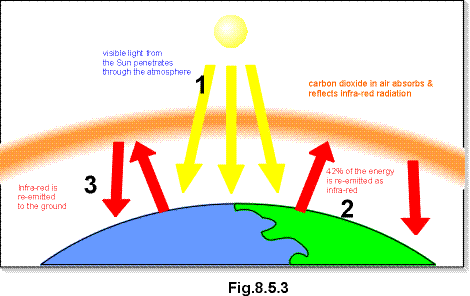
As visible light from the Sun reaches the ground,
it is absorbed by objects on the Earth surface. Eventually, infra-red radiation
is emitted. |
1 |
|
The carbon dioxide in the air absorbs the infra-red
radiation and re-emits back to the Earth. As a result, the Earth temperature
is increased. |
0.5 |
|
Global warming will cause shift in climate
zone, death of fish, dislocation of agriculture and rise of sea level.
The most recent El Nino Effect has caused draught in Malaysia in the Summer
of 1997 for several months, leading to a large scale hill fire. |
0.5 |
|
|
|
|
ii)
the acid rain. |
|
| |
|
|
|
Burning of fossil fuels gives off sulphuric
dioxide and nitrogen dioxide. When they react with water droplets in clouds,
sulphuric acid and nitric acid are formed. |
1 |
|
The rain which contains these acid has a pH
less than 7.0 and is known as acid rain. |
|
|
Acid rain can cause horrible environment damage
as it rots buildings, rusts cars, damage soil, kill fishes in lakes and
destroys trees. |
1 |
|
|
|
| c. |
Based
on any TWO renewable energy sources, discuss the practical difficulties
in using them. |
4
marks |
|
|
|
|
Solar energy |
Any two |
|
The equipment required to collect solar energy,
generate electric energy and store them up are expensive and large in size. |
2 m each |
|
Sunlight is not easy to collect in urban city.
The tall buildings blocks sunlight from reaching every home. |
|
|
Also, sunny day is not often in some countries. |
|
|
Energy from wind |
|
|
Very large windmills are needed and sites where
there is enough and continuous supply of wind are not easily available. |
|
|
The electrical energy generated by the windmills
are difficult to store up for further use. The huge windmill will also
cause interference to television reception. |
|
|
Hydropower |
|
|
The cost in building building and maintaining
the dams is very high. Building dams also causes environmental damage. |
|
|
Tidal and wave power |
|
|
The tidal power plants are expensive. They
are threatened by corrosions by sea water and also by damages from storms. |
|
|
Geothermal energy |
|
|
Very deep tunnels have to be built to reach
the heat beneath the Earth crust. Energy is obtained from the steam produced
as a result of passing water through the tunnels. |
|
|
Large scale analysis on the Earth crust has
to be done before building the tunnels. The cost of constructing the tunnels
is high. The operation is complicated. |
|