| a. |
State
and discuss the differences between
i)
real gas and ideal gas |
5
marks |
|
|
|
|
A real gas has intermolecular force while an
ideal gas does not. |
1 |
|
A real gas could be liquefied or solidified. |
1 |
|
A real gas does not obey the Boyle's Law at
low temperature or high pressure. |
1 |
|
(Marks are deducted
for answer: ideal gas molecules collide elastically but real gas inelastically) |
|
|
|
|
|
ii)
heat and internal energy. |
|
|
|
|
|
Heat is the energy transfer as a result of temperature
difference. |
1 |
|
Internal energy is the sum of kinetic energy and potential
energy of the molecules of a substance. |
1 |
|
|
|
| b. |
Explain
in terms of the kinetic theory what happens to the energy supplied to a
gas when it is heated
i)
at constant volume |
6
marks |
|
|
|
|
When a gas is heated at constant volume, the
energy goes completely to the internal energy of the gas. There is no work
done by the gas. |
1 |
|
For one mole of a monatomic ideal gas, the
internal energy is equal to |
|
|
 |
1 |
|
Thus, in the process of constant volume, the
heat required is |
|
|
 |
1 |
|
|
|
|
ii)
at constant pressure
For each of the above processes, find an expression for the heat energy
required for the temperature of one mole of an ideal monatomic gas to increase
by DT. |
|
|
|
|
|
When a gas is heated at constant pressure,
the energy goes partially to the internal energy of the gas and partially
to do work against the gas pressure. |
1 |
|
Suppose the gas volume increases from V1
to V2, the work done by the gas is |
|
|
 |
1 |
|
Thus, in the process of constant pressure,
the heat required is |
|
|
 |
1 |
|
|
|
| c. |
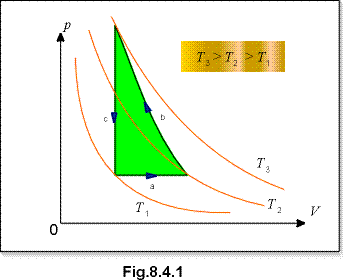
A
fixed mass of gas is contained in a vessel with a movable piston. The following
actions are performed sequentially on the gas:
a.
the gas is heated at constant pressure until its volume is doubled
b.
the gas is then compressed quickly so that its volume is restored to the
original value
c.
the piston is held fixed and the vessel is cooled until the temperature
is also restored to the original value.
Sketch a p-V graph to represent the sequential actions on the gas. Explain
the physical meaning of the area enclosed by the curves. |
5
marks |
|
|
|
|
 |
3 |
|
There is a net work done on the gas. Work done
by the gas is negative, W < 0. |
1 |
|
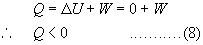
After one complete cycle, the net change in
internal energy is zero. DU = 0. |
|
|
By the 1st Law of Thermodynamics,
 |
|
|
The area represents a net heat flow out of
the system. |
1 |
|
|
|