| a. |
What
do you understand by the ‘average separation between molecules’? Explain
how the average separation is related to the measurable volume of a given
substance. |
3
marks |
| |
|
|
|
The average separation between molecules is
the distance between the centers of adjacent molecules when they are regarded
as evenly distributed in a given volume. |
1 |
|
 |
1 |
|
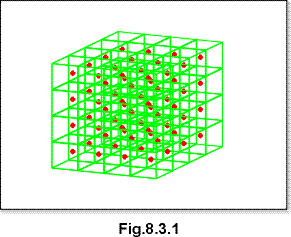
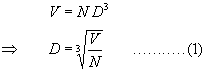
Since the size of a molecule is very small
(especially in a gas), we can regard each molecule as occupying a cube
of side D. N such cubes make up the total volume V.
Thus, the average separation between molecules is |
|
|
 |
1 |
| |
|
|
| b. |
When
liquid turns into gas under atmospheric pressure, the typical increase
in volume is 750 times as great. Find a value for the typical increase
in the average separation. |
2
marks |
| |
|
|
|
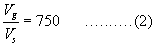
The ratio of volumes in gaseous form to liquid form is |
|
|
 |
|
|
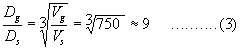
Thus, the ratio of separations is |
|
|
 |
2 |
| |
|
|
| c. |
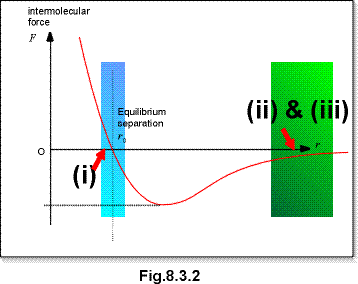
Sketch
a graph to show the variation of the intermolecular force with the separation
between the centers of two molecules.
A sample of gas is contained in a fixed volume vessel. Mark on your diagram
to show
i)
the relative positions of the molecules during collision. |
6
marks |
|
ii)
the normal separation at low temperature. |
|
|
iii)
the normal separation at high temperature. |
|
| |
|
|
|
 |
|
|
Note: |
|
|
-
When the molecules collide, the molecules penetrate into each other. Work
is done against the intermolecular repulsion. (k.e. is converted into intermolecular
p.e. temporarily). Thus, their separation is less than the equilibrium
separation ro.
-
In a gas, the normal (average) separation depends on the volume of the
gas and the amount of molecules only. It is independent of the temperature.
|
|
|
|
|
| d. |
The
van der Waal’s equation of state is written as
( p + a ) (V - b) = n R T
where a and b are
quantities depending on n.
Explain how this
equation describes the behaviour of a real gas. |
5
marks |
| |
|
|
|
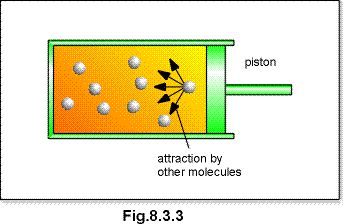
Unlike an ideal gas, there is intermolecular
force in a real gas. |
|
|
Intermolecular attraction
force |
|
|
 |
0.5 |
|
This reduces the pressure of the gas because
when the molecules hit the wall of the container, they are retarded by
the unbalanced attractive force due to molecules behind. |
1 |
|
Thus, the measured pressure p is less
than the pressure due to an ideal gas under the same condition. A positive
constant a is added to p. i.e. (p + k) is the
pressure due to an ideal gas under the same condition. |
0.5 |
|
Also, it causes the gas molecules to come together
at low pressure in the course of condensation. Thus, it accounts for the
other phases of real matter. |
1 |
|
Intermolecular repulsive
force |
|
|
As molecules come very close to each other,
they repel. Thus, the effective volume of a molecule is non-zero. This
reduces the space in which other molecules could move. |
1 |
|
The measured volume V is greater than
the actual 'free volume'. Thus, a negative correction b should be
made to V. i.e. (V - b) is the free-volume in which gas molecules
can move. |
1 |
|
|
|