| a. |
Describe
the simple kinetic theory model of an ideal gas, stating the four assumptions
on which your model is based. (No mathematical derivation is required.) |
4
marks |
| |
|
|
|
In kinetic theory, gas is made up of molecules
which are moving at high speed. The pressure of a gas is caused by the
collision of the molecules with the container. |
1 |
|
An ideal gas has the following microscopic
properties: |
|
|
-
there is no intermolecular force, neither attractive nor repulsive
-
the volume of a molecule is zero
-
the collisions between molecules and the container are perfectly elastic
-
the molecules are in constant random motion
|
3 |
| |
|
|
| b. |
This
theory leads to the equation 
where p is the pressure
of the gas, r is its density and  is the mean square speed. Explain the meaning of the terms underlined.
Discuss how this equation is related to Boyle’s Law.
is the mean square speed. Explain the meaning of the terms underlined.
Discuss how this equation is related to Boyle’s Law. |
4
marks |
| |
|
|
|
Pressure of a gas is the force acting on unit area of the
container. It is caused by the collisions of the molecules with the container,
leading to a change in momentum. |
1 |
|
Mathematically, |
|
|
 |
|
|
Density refers to the amount of substance in a given volume.
It is defined as the mass of gas per unit volume. |
1 |
|
Mathematically, |
|
|
 |
|
|
Mean square speed is the average of the square of the speed
of the molecules. |
1 |
|
Mathematically, |
|
|
 |
|
|
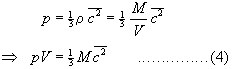
The given equation  is derived from a consideration of microscopic properties, while
Boyles' Law is derived from experimental results. However, we can prove
that they are consistent:
is derived from a consideration of microscopic properties, while
Boyles' Law is derived from experimental results. However, we can prove
that they are consistent: |
|
|
 |
0.5 |
|
where M is the total mass of the gas. |
|
|
Since the mean square speed is unchanged for constant temperature,
equation (4) can be written as |
|
|
 |
0.5 |
| |
|
|
| c. |
Derive
an expression for the total translational kinetic energy of the gas molecules
in terms of the ideal gas temperature T. Explain why your result may not
represent the internal energy of a sample of gas. |
4
marks |
| |
|
|
|
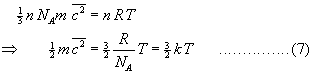
From Ideal Gas Law, we have
 |
|
|
where n is the number of moles. From
equation (4), |
1 |
|
 |
|
|
where NA is the Avogadro's
number. |
|
|
Combining (5) and (6), we have |
|
|
 |
1 |
|
where k is a constant. |
|
|
Thus, the average translation k.e. is
 |
|
|
The total translational k.e. is |
|
|
 |
1 |
|
This equation may not represent the internal
energy of a sample of gas because |
|
|
-
gas molecules also have rotational kinetic energy
-
gas molecules also have intermolecular potential energy
|
1 |
|
|
|
| d. |
What
causes the behaviour of real gases to differ from that of an ideal gas?
Explain qualitatively why the behaviour of all gases at very low pressures
approximates to that of an ideal gas. |
4
marks |
| |
|
|
|
A real gas is different from an ideal gas because
of the intermolecular force. |
|
|
Intermolecular attraction force |
|
|
This reduces the pressure of the gas because
when the molecules hit the wall of the container, they are retarded by
the unbalanced attractive force due to molecules behind. |
1 |
|
Also, it causes the gas molecules to come together
at low pressure in the course of condensation. Thus, it accounts for the
other phases of real matter. |
1 |
|
Intermolecular repulsive force |
|
|
As molecules come very close to each other,
they repel. Thus, the effective volume of a molecule is non-zero. This
reduces the space in which other molecules could move. |
1 |
|
At very low pressure, the molecules are widely
separated. Since the intermolecular force is negligible for large molecular
separation, a real gas behaves like an ideal gas. |
1 |
|
|
|