| a. |
Explain
how the Celsius temperature is defined in terms of the thermometric properties
of a thermometer. Give a clear account on the fixed points used in the
Celsius scale. |
4
marks |
| |
|
|
|
Celsius temperature uses the freezing point
and boiling point of pure water at standard atmospheric pressure (760 mm
mercury) as the lower fixed point and the upper fixed point. |
1 |
|
The lower fixed point is defined as 0oC
and the upper fixed point 100oC. |
1 |
|
Suppose X0 and X100
are the values of the thermometric substance at 0oC and 100oC
respectively. |
1 |
|
The temperature in degree Celsius corresponding
to a value X is |
|
|
 |
1 |
| |
|
|
| b. |
Sketch
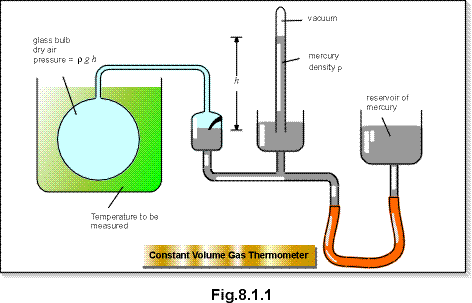
a diagram for a constant volume gas thermometer. Discuss how the Celsius
temperature could be obtained from the thermometer. |
3
marks |
| |
|
|
|
 |
1.5 |
|
At high temperature, the gas expands. To restore to its
original volume, the reservoir of mercury is raised. |
|
|
The pressure of the gas is |
|
|
 |
0.5 |
|
Before the thermometer can be used, the pressure at ice
point and boiling point of water are measured, namely, p0
and p100. |
|
|
If the pressure for an unknown temperature is p,
the Celsius temperature is |
|
|
 |
1 |
| |
|
|
| c. |
Describe
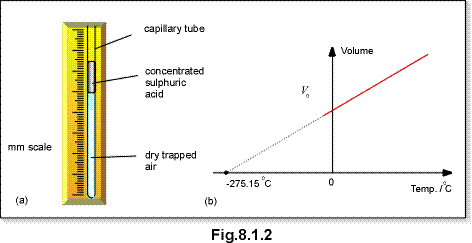
an experiment to investigate the relationship between the volume of a fixed
mass of dry gas and the Celsius temperature maintained at atmospheric pressure.
Explain how the absolute zero could be obtained from the experiment. |
4
marks |
| |
|
|
|
 |
1 |
|
A fixed mass of air is trapped in a uniform
capillary tube by a thread of concentrated sulphuric acid, which keeps
the air dry and maintains a constant pressure. |
0.5 |
|
The tube is heated in a water bath. |
0.5 |
|
As the temperature increases, the air trapped
expands. The volume is taken after the reading goes steady for one or two
minutes. |
1 |
|
Plot the volume against the Celsius temperature. |
|
|
Extend the graph to cut the temperature axis.
Absolute zero is the intercept at the temperature axis. |
1 |
| |
|
|
| d. |
What
is meant by the triple point of water? Discuss how triple point of water
could be obtained using a triple point cell. Hence, state the advantage
of using triple point of water as a fixed point for temperature scale over
the use of ice point. |
3
marks |
| |
|
|
|
Triple point of water is the temperature at
which ice, water and water vapour co-exist in equilibrium in the absence
of air. |
|
|
 |
|
|
The triple point of water is obtained by using
a triple point cell. It is made by putting ice into a glass vessel and
then remove the air and seal the tube. When ice starts to melt inside the
temperature is always 0.01oC. |
|
|
The advantages of using a triple point cell
are |
|
|
-
the temperature is precisely reproducible
-
independent of the atmospheric pressure
|
|
| |
|
|
| e. |
The
ideal gas temperature scale uses the absolute zero and the triple point
of pure water as two fixed points. Discuss how the ideal gas temperature
could be obtained from a constant volume gas thermometer. |
2
marks |
| |
|
|
|
In the ideal gas scale, the lower fixed point
is the absolute zero, which is the lowest temperature attainable: 0 K =
-273.15oC. |
|
|
The other fixed point is the triple point of
water: Ttr = 273.16 K |
|
|
Before the constant volume gas thermometer
can be used, the pressure at the triple point is measured. |
|
|
The pressure under constant volume varies linearly
with the ideal gas temperature which is defined as |
|
|
 |
|