| a. |
Show
that the hydraulic pressure due to a liquid of density r at a depth h is
equal to
r
g h. |
2
marks |
|
|
|
|
 |
0.5 |
|
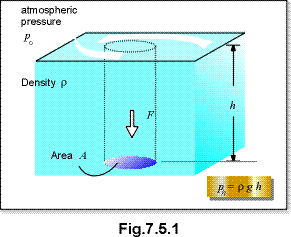
Consider a small horizontal area A at
a depth h below the liquid surface. The force acting on A
due to the weight of the liquid column is |
|
|
 |
0.5 |
|
Thus, the hydraulic pressure at depth h
is |
|
|
 |
1 |
|
|
|
| b. |
State
the Archimedes’ principle and illustrate the principle by referring to
the difference in the pressures at the upper and lower surfaces of a cylindrical
block fully immersed in a liquid. |
3
marks |
|
|
|
|
Archimedes' Principle |
|
|
When an object is wholly or partially immersed in a fluid,
the upthrust on the object is equal to the weight of the fluid displaced. |
1 |
|
 |
0.5 |
|
Consider a cylindrical block of area A and height
H immersed at a depth of h beneath a liquid of density r. |
|
|
The upper surface experiences a downward force due to the
liquid pressure: |
|
|
 |
0.5 |
|
The lower surface experiences an upward force due to the
liquid pressure: |
|
|
 |
0.5 |
|
Since Fb > Ft, there is an
upward force acting on the block due to the liquid: |
|
|
 |
0.5 |
|
where V= AH is the volume of the cylindrical
block. |
|
|
Thus, upward force is known as the upthrust. |
|
|
|
|
| c. |
Describe
the procedures to set up a mercury barometer and explain how it can be
used to measure the atmospheric pressure. |
5
marks |
| |
|
|
|
 |
|
|
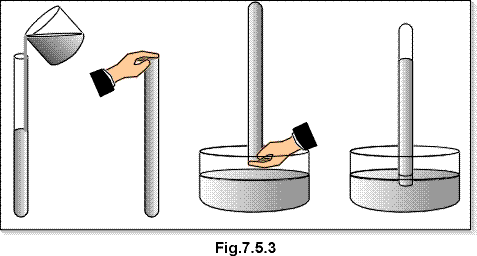
Steps in setting up a mercury barometer: |
|
|
-
Carefully pour mercury into a cylindrical tube (sealed at the lower end)
until it is brim full.
-
Close the opening with a finger.
-
Invert the tube and lower it into a large trough of mercury.
-
Remove the finger
|
2 |
|
 |
1 |
|
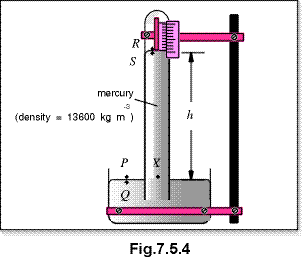
The mercury column is held up by the atmospheric
pressure acting on the surface of the mercury in the reservoir. |
|
|
The region above the mercury column inside
the tube is a vacuum. |
|
|
Thus, the pressure at S and R are zero. |
0.5 |
|
The pressure at X is due to the hydraulic pressure
of the mercury column: |
|
|
 |
1 |
|
The atmospheric pressure is equal to the pressure
at P, Q or X as they are all at the same level. |
0.5 |
|
|
|
| d. |
Discuss
how much water is needed to float a ship. |
3
marks |
| |
|
|
|
 |
1 |
|
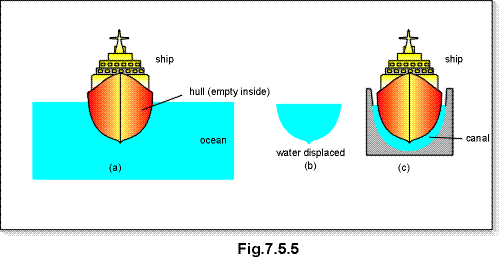
A ship floating in water displaces water which
has the same weight as the ship. |
1 |
|
The amount of water is displaced somewhere
else and need not be present to float the ship. |
|
|
Thus, if the shape of the canal is approximately
the same as the hull of the ship, the amount of water needed is a thin
film between the ship and the canal. |
1 |
|
|
|
| e. |
Explain
why a water pump located on the ground may fail to pump water out of a
deep well. |
3
marks |
| |
|
|
|
 |
1 |
|
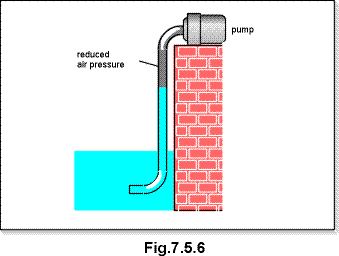
A pump located on the ground is to reduce the
pressure within the pipe. It makes use of the greater atmospheric pressure
outside to push to water up the pipe. |
1 |
|
However, if the well is too deep, the air pressure
inside may be reduced to zero. This is similar to the space above the mercury
barometer. |
1 |
|
|
|
|
|
|
|
|
|