| a. |
The
force between two molecules may be regarded as an attractive force which
increases as their separation decreases and a repulsive force which is
only important at small separation. Sketch graphs for
i)
force-separation (F-r) |
6
marks |
| |
|
|
|
 |
2 |
| |
|
|
|
ii)
potential energy-separation (U-r).
On each graph, mark the equilibrium distance. On graph ii), indicate the
energy which would be needed to separate two molecules initially at equilibrium
position. Shade the regions for the positions of molecules in solid, liquid
and gaseous states.
Using your graph(s), explain why energy is stored in a material when it
is compressed. |
|
| |
|
|
|
 |
3 |
|
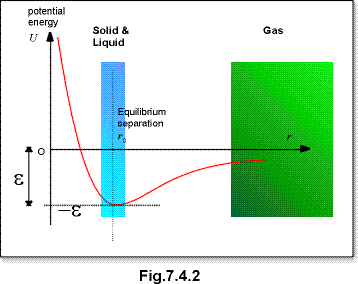
In the graph, e is the energy
required to separate two molecules initially at equilibrium position. |
|
|
When a material is compressed, the intermolecular separation
decreases. From the graph in Fig.7.4.2, the potential energy between molecules
increases. |
1 |
| |
|
|
| b. |
Explain
how the F-r graph can be obtained from the U-r graph. |
2
marks |
| |
|
|
|
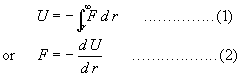
Force and potential energy are related by |
|
|
 |
|
|
Thus, the slope of the U-r graph gives the
intermolecular force. |
|
|
|
|
| c. |
Give
an account on the energy involved during the phase changes of matter
i)
from solid to liquid, |
5
marks |
| |
|
|
|
When solid is melted into liquid, latent heat
of fusion is required. |
0.5 |
|
The energy is break the lattice structure in
solid so that molecules are mobile. |
1 |
|
|
|
|
ii)
from liquid to gas.
Derive an expression for the energy required for vaporizing one mole of
a liquid in terms of the quantities you have marked in the U-r graph in
part (a). |
|
| |
|
|
|
When liquid is vaporized into gas, latent heat
of vaporization is required. |
0.5 |
|
During vaporization, molecules are pulled apart
from their equilibrium position to infinity. |
0.5 |
|
Work is done against the intermolecular attraction
between the molecules. |
0.5 |
|
From Fig.7.4.2, the bond energy between each
pair of molecules is e. Suppose each molecule
is surrounded by n neighbouring molecule. |
|
|
Since a bond is formed by two molecules, the
energy to vaporize one molecule is |
|
|
 |
1 |
|
Thus, the energy to vaporize one mole of molecules
is |
|
|
 |
1 |
|
where NA is the Avogadro's
number. |
|
| |
|
|
| d. |
Discuss
how the average separation between molecules can be estimated from the
volume of a pure material and the amount of the atoms inside. |
3
marks |
| |
|
|
|
Consider a substance consisting of N
molecules and having a volume V. |
|
|
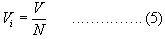
The volume occupied by each molecule is |
|
|
 |
1 |
|
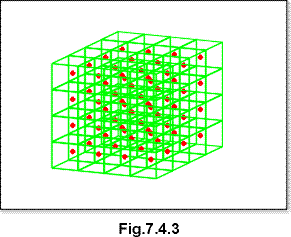
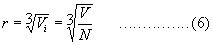
The substance can be viewed as made up of N
cubes of equal size. The separation of molecules is thus the distance between
the centres of the adjacent cubes. |
|
|
 |
1 |
|
Thus, the average separation between molecules
is |
|
|
 |
1 |