| a. |
Define
the force constant for a copper wire and explain how the value depends
on the physical dimension of the wire. |
3
marks |
|
|
|
|
The force constant of a copper wire is defined
as the applied force required for unit extension of the wire. |
0.5 |
|
 |
0.5 |
|
 |
|
|
|
|
|
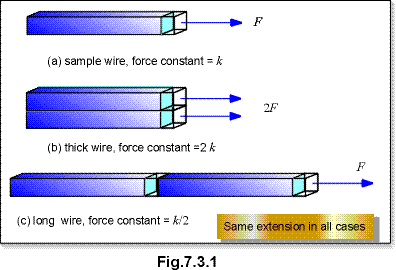
k is proportional to the cross-sectional
area: |
0.5 |
|
If the force required to extend a single wire
is F, the force required to extend two such wires in parallel by
the same amount is 2F. |
0.5 |
|
k is inversely proportional to the length: |
0.5 |
|
If the force required to extend a single wire
by e is F, the same force could cause two such wires in series
by 2e, because each wire extends by e. |
0.5 |
| |
|
|
| b. |
Sketch
the form of the force-distance curve between atoms of a solid and discuss,
with reference to your graph,
i)
why most solids appear to obey Hooke’s Law. |
6
marks |
| |
|
|
|
 |
1 |
|
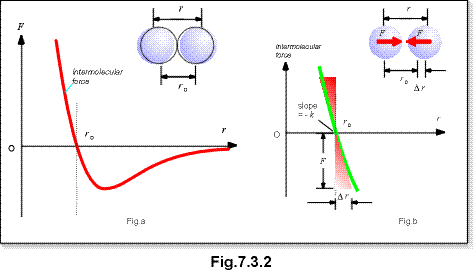
The F-r graph is almost a straight line very close
to ro. Thus, the restoring force between molecules is
proportional to the change in separation Dr,
for small Dr. |
1 |
|
Mathematically,

where k is the force constant between the molecules. |
1 |
|
This explains why most solid obeys the Hooke's Law. |
|
| |
|
|
|
ii)
the motion of atoms in the solid. |
|
| |
|
|
|
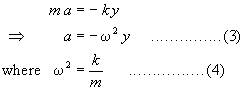
Molecules possess kinetic energy at room temperature.
When their displacement from the equilibrium position is y = Dr,
the acceleration is given by |
1 |
|
 |
1 |
|
This equation shows that the molecules are
performing simple harmonic motion about their equilibrium positions. |
1 |
| |
|
|
| c. |
State
the differences between
i)
strength and stiffness |
7
marks |
| |
|
|
|
Strength refers to the ability of a substance
to withstand stress before breaking. Breaking stress measures the strength. |
0.5 |
|
Stiffness refers to the reluctance of a substance
to deformation by external force. Young modulus measure the stiffness. |
0.5 |
| |
|
|
|
ii)
ductile and brittle |
|
| |
|
|
|
A ductile material can be drawn into a wire
or rolled into a thin sheet. It has a long region of plastic deformation
in the s-e graph. |
0.5 |
|
A brittle material is easily broken into pieces,
like glass. There is virtually no plastic deformation. |
0.5 |
| |
|
|
|
iii)
metal fatigue and creep
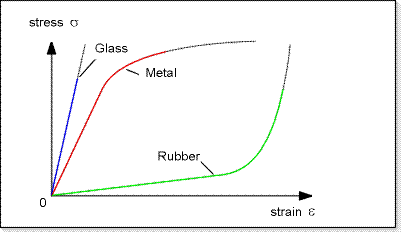
Using the same axes, sketch the stress-strain graphs for a metal, glass
and rubber. With reference to your sketch, explain the different behaviour
of the materials. |
|
| |
|
|
|
Metal fatigue refers to an object which breaks
even the stress is lower than the breaking stress. This is caused by stress
which changes periodically. |
1 |
|
Creep refers to the gradual elongation of a
material under a constant stress that is well below its yield point. This
usually occurs at high temperature. A large sheet of lead erected vertically
will easily creep. |
1 |
|
 |
1.5 |
|
Glass is stiff and brittle. |
0.5 |
|
Metals usually have a long region of plastic
deformation. They are ductile. |
0.5 |
|
Rubber is elastic (can deform easily) before
the elastic limit is reached. However, after the elastic limit is reached,
rubber is difficult to cause further extension (stiffer). |
0.5 |
|
|
|