| a. |
Define
the terms tensile stress and tensile strain and explain why these quantities
are more useful than force and extension for a description of the elastic
properties of matter. |
3
marks |
|
|
|
|
Tensile stress is defined as the force
F acting on unit cross-sectional area A, i.e. |
|
|
 |
1 |
|
Tensile strain is defined as the extension
of unit unit. If e is the extension and l is the natural
length, then |
|
|
 |
1 |
|
The extension produced in a sample of material
depends on |
|
|
-
the natural of the material
-
the applied force
-
the cross-sectional area of the sample
-
the original length
|
0.5 |
|
For the same force, the larger is the cross-sectional
area, the smaller is the extension; |
|
|
the longer is the original length, the larger
is the extension. |
|
|
To enable fair comparison of elastic properties
between two materials, stress and strain are more appropriate. |
0.5 |
|
|
|
| b. |
State
Hooke’s Law for a pure material and describe, with the aid of a rough graph,
the behaviour of a copper wire which hangs vertically and is loaded with
a gradually increasing load until it finally breaks. |
4
marks |
|
|
|
|
Hooke's Law for a pure material: |
|
|
The stress applied to any solid is proportional to the
strain it produces for small strain. |
1 |
|
Mathematically, |
|
|
 |
|
|
 |
1 |
|
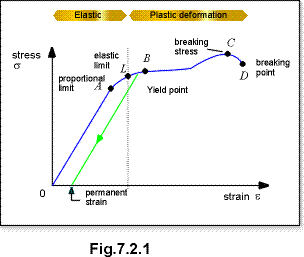
For small stress, the stress is proportional to the strain,
until the proportional limit is reached. |
0.5 |
|
Before the elastic limit is reached, the wire could return
its original shape if the stress is removed completely. After the elastic
limit is reached, there would be permanent deformation as shown in the
green line in Fig.7.2.1. |
0.5 |
|
Yield point is a position when there is a sudden increase
in strain. |
0.5 |
|
Breaking stress is the minimum stress for the wire to break. |
|
|
Before the wire breaks, there is a constriction in the
wire, causing the cross-sectional area to decrease quickly. |
0.5 |
|
|
|
| c. |
Give
a brief account on the attractive and repulsive components of intermolecular
force and discuss how the intermolecular force varies with the separation
of the molecules. Hence, explain why both solid and liquid have fixed volume. |
5
marks |
|
|
|
|
The intermolecular force is resultant of attractive
and repulsive force between molecules. |
|
|
 |
1 |
|
The attractive component is caused by the electrostatic
attraction between electrons of one molecule and the protons of another
molecule. |
1 |
|
The repulsive component is caused by the electrostatic
repulsion between the outer electrons of two molecules when the molecules
are brought too close to each other. |
1 |
|
Both the attractive and repulsive components
decrease as the separation increases. |
|
|
However, when the two forces are added, there
is a position in which the resultant is zero, called the equilibrium
separation ro. |
1 |
|
When the separation is less than ro,
the repulsive component is larger. |
0.5 |
|
When the separation is more than ro,
the attractive component is larger. |
0.5 |
|
This explains why liquid and solid have fixed
volume. |
|
|
|
|
| d. |
Using
a graph of potential energy - separation between molecules in a solid,
accounts for the thermal expansion. |
4
marks |
|
|
|
|
 |
1 |
|
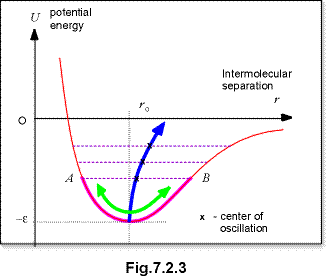
Molecules in a solid are continuously vibrating
about a point, called centre of oscillation. |
1 |
|
As temperature increases, the total energy
of the molecules increases. |
|
|
Thus, the potential energy increases. |
1 |
|
However, the U-r graph is not symmetrical
about ro. Instead, centre of oscillation moves to the
right as temperature increases. |
1 |
|
Effectively, the molecules occupy a larger
volume at higher temperature. This explains the thermal expansion of molecules. |
|