| a. |
Distinguish
between elastic deformation and plastic deformation. Using metal as an
example, discuss the behaviour of the molecules of a substance under an
applied stress. |
4
marks |
| |
|
|
|
In elastic deformation, when the applied stress
is removed, the object will always resume its original shape and size. |
1 |
|
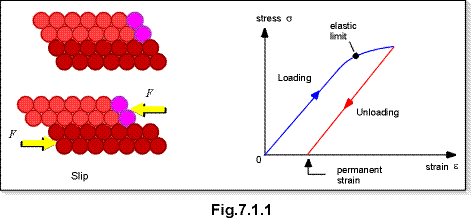
In plastic deformation, there is a permanent
strain when the applied force is removed. |
1 |
|
 |
1 |
|
Metal atoms are arranged in a regular pattern.
When the applied stress is small, the atoms displaced slightly. |
|
|
When the applied stress is large, layers of
molecules slide over each other and reform the regular pattern as shown
in Fig.7.1.1. Slip occurs and there is permanent deformation. |
1 |
| |
|
|
| b. |
Define
Young Modulus and explain how this quantity affects the behaviour of a
substance. Describe how you would find the value for a copper wire. |
6
marks |
| |
|
|
|
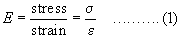
Young Modulus E is defined as the ratio of
tensile stress applied to a body to the tensile strain produced. |
0.5 |
|
(E is the stress per unit strain). |
|
|
Mathematically,
 |
0.5 |
|
Young modulus indicates the stiffness of a substance. The
higher is E, the more reluctant is the substance to elastic deformation. |
1 |
|
|
|
|
Determination of Young modulus of copper |
|
|
 |
1 |
|
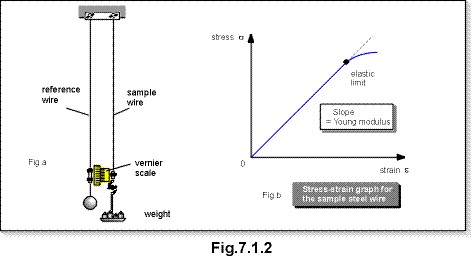
Suspend two identical copper wires from a stout support.
The sample wire is caused to extend by putting weights to its lower end.
The other wire is used as a reference wire. |
|
|
Before weights are added, measure the length l and
the diameter d of the sample wire using a metre rule and a micrometer
screw gauge respectively. The extension e is recorded by a vernier
scale. |
1 |
|
The stress on the sample wire is caused by the added weight
mg:
 |
0.5 |
|
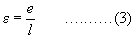
The strain is given by
 |
0.5 |
|
Tabulate the stress and the corresponding strain for different
weights added. Plot a graph of stress against strain as shown in Fig.b.
The slope of the straight portion gives the value of E for copper:
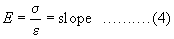 |
1 |
| |
|
|
| c. |
What
is meant by the force constant between molecules? Discuss how this microscopic
quantity can be related to the measurable quantity of the substance? |
6
marks |
| |
|
|
|
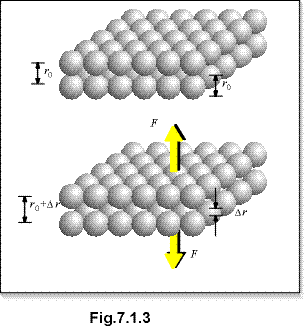
Intermolecular force exists between molecules.
When two molecules are pulled apart, the restoring force f is proportional
to the change in separation Dr. |
|
|
Mathematically,

The proportional constant is called the force constant between molecules. |
1 |
|
 |
1 |
|
Consider a wire made up of layers of molecules.
In each layer, there are N molecules each of diameter ro.
The cross-sectional area of the wire is
 |
|
|
Suppose the applied force on the wire is F.
The adjacent layers of molecules are pulled apart by a small distance Dr.
The stress is |
|
|
 |
1 |
|
The strain is |
|
|
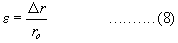 |
1 |
|
Thus, the Young Modulus of the substance is |
|
|
 |
1 |
|
This equation bridges the macroscopic and microscopic
worlds: the Young Modulus being a measurable quantity and the force constant
between molecules being a microscopic quantity. |
1 |
|
|
|