| a. |
State
the Newton’s Second Law for rotational motion and explain the conditions
in which the angular momentum of a rotating object remains constant. |
3
marks |
|
|
|
|
Newton's Second Law for Rotation |
|
|
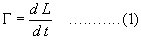
The torque acting on a rotating system is equal to the
time rate of change of angular momentum of that body. |
0.5 |
|
Mathematically,
 |
0.5 |
|
For a rigid body (I does not change), |
|
|
 |
1 |
|
|
|
|
From equation (1), if the external torque is zero, the
rate of change of angular momentum is zero, i.e. the angular momentum remains
constant. |
1 |
| |
|
|
| b. |
Show
that the area swept out in a given time by the line joining any planet
to the Sun is always the same. Hence, explain why the speed of a satellite
moving in an elliptical orbit is continuously changing. Account for the
change in kinetic energy of the satellite. |
6
marks |
| |
|
|
|
 |
1 |
|
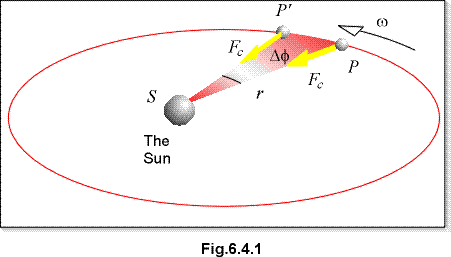
Consider a planet P moving in an elliptical orbit
round the Sun which is at a distance r from it. In a short time
interval Dt, the angular displacement
is |
|
|
 |
1 |
|
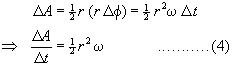
The area swept out by the line joining P and the Sun is
approximately a triangle of area: |
|
|
 |
1 |
|
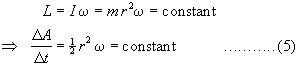
Since the force between P and the Sun does not produce
any torque on P, the angular momentum of P is constant. Thus, |
|
|
 |
1 |
|
In other words, the area swept out per unit time is constant. |
|
|
As the planet is moving closer to the Sun, r decreases,
w increases and the planet moves faster. |
1 |
|
The gain in kinetic energy is due to a loss in gravitational
p.e. |
1 |
| |
|
|
| c. |
Suggest
two different ways in which the orientation of a satellite can be varied.
You may assume that the satellite carries a small rocket and a flywheel. |
3
marks |
| |
|
|
|
Using rocket |
|
|
The satellite can fire the rocket at right angle to its path
of motion. This produces an impulse at right angle to the path, causing
a change in direction.
|
1.5 |
|
Using flywheel |
|
|
To change the orientation, a flywheel is started up. Since
the total angular momentum is conserved, the satellite will start to rotate
in the opposite direction as the flywheel.
|
1.5 |
| |
|
|
| d. |
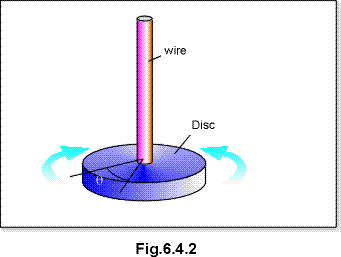
A disc
is suspended horizontally from the ceiling by a wire. Show that when the
wire is twisted and is released, the disc will undergo simple harmonic
motion in a horizontal plane. Derive an expression for the period of motion
in terms of the moment of inertia of the disc and the torsional constant
of the wire. |
4
marks |
| |
|
|
|
 |
1 |
|
If a wire is twisted through an angle q,
the restoring couple is |
|
|
 |
1 |
|
where c is called the torsional constant
of the wire. |
|
|
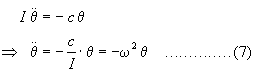
When a disc is set into oscillation, the equation
of motion is given by |
|
|
 |
1 |
|
This shows that the motion is simple harmonic. |
|
|
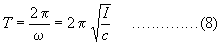
The period of oscillation is |
|
|
 |
1 |
|
|
|