| a. |
What
is the physical significance of the moment of inertia of a rigid body? |
2
marks |
| |
|
|
|
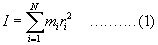
The moment of inertia of a rigid body about
an axis is defined as |
|
|
 |
1 |
|
where mi is the mass of the
ith particle at a distance ri from the axis. |
|
|
It measures the resistance of the rigid body
to change in rotational motion. |
1 |
| |
|
|
| b. |
State
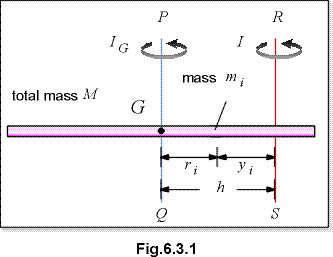
the parallel axes theorem. Illustrate the theorem by referring to a rod
rotating about an axis that does not pass through the center of gravity. |
3
marks |
| |
|
|
|
Parallel Axes Theorem |
|
|
The moment of inertia of a body about any axis is equal
to the sum of its moment of inertia about a parallel axis through the centre
of gravity and the product of the mass of the body and the square of the
separation of the axes |
|
|
Mathematically, for a rigid body of mass M about
an axis which is at a distance h from the centre of gravity G, |
|
|
 |
|
|
where IG is the moment of inertia about
an axis parallel to the given axis and passes through G. |
1 |
|
 |
1 |
|
Suppose PQ and RS are two parallel axes with
PQ passing through G. Consider the ith particle. |
|
|
 |
|
|
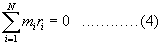
The moment of force about G is always zero. Thus, |
|
|
 |
|
|
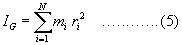
The moment of inertia of the rod about PQ is |
|
|
 |
|
|
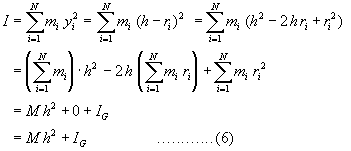
Thus, the moment of inertia of the rod about RS
is |
|
|
 |
1 |
| |
|
|
| c. |
A
rigid body of mass M is pivoted about a point which is at a distance L
from the center of gravity as shown.
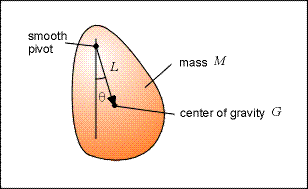
Show that if the
rigid body is displaced slightly from the equilibrium position and released,
it would perform simple harmonic motion. Derive an expression for the period
of oscillation. You may assume that the moment of inertia of the body about
its centre of gravity is IG. |
5
marks |
| |
|
|
|
 |
1 |
|
The moment of inertia about the pivot is |
|
|
 |
1 |
|
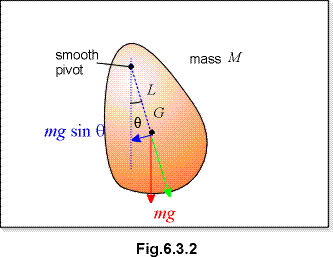
Resolve the weight mg into two component
as shown. |
|
|
The torque due to the weight is |
|
|
 |
1 |
|
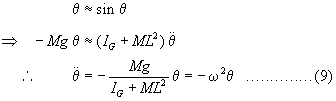
For small oscillation,
 |
1 |
|
Thus, the motion is simple harmonic. |
|
|
The period of oscillation is |
|
|
 |
1 |
|
|
|
| d. |
Two
solid cylinders of different masses and different radii are released from
the top of a rough inclined plane simultaneously. Show that their linear
speeds are the same when they reach the bottom of the plane. Hence, show
that they always roll side by side along the inclined plane. |
4
marks |
| |
|
|
|
The moment of inertia of a cylinder about the
axis through centre and at right angle to the cross-sectional area is |
|
|
 |
|
|
 |
1 |
|
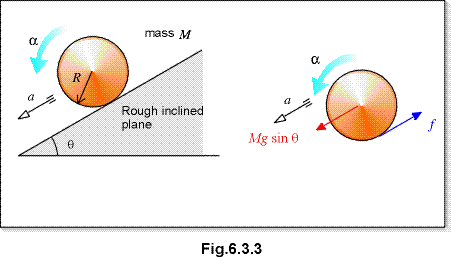
As the cylinder rolls down, a static friction
f points up the incline. |
|
|
The acceleration is given by |
|
|
 |
0.5 |
|
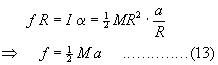
The static friction accounts for the rotational
motion by providing a torque: |
|
|
 |
1 |
|
Solving (12) and (13), we have |
|
|
 |
0.5 |
|
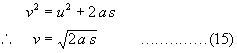
Suppose the length of the incline is s. |
|
|
The speed on reaching the bottom is given by |
|
|
 |
0.5 |
|
Thus, the two cylinders reach the bottom with
the same speed. |
|
|
Since the average speeds of the cylinders are
equal, they roll side by side irrespective of their difference in mass
and radius. |
0.5 |
|
|
|
| e. |
Suggest
how, by experiment, you can identify whether a cylinder is a solid or a
hollow one. |
2
marks |
| |
|
|
|
The final speed of an object rolling down an
incline plane depends on the moment of inertia.
An object rolling down an inclined plane lose gravitational p.e. The
object with a larger moment of inertia would have a larger rotational kinetic
energy and thus a relatively smaller translational k.e. |
1 |
|
As a result, the hollow cylinder having a larger
I would reach the bottom later. |
1 |
|
|
|