| a. |
A
rotating system consists of N particles located at different positions
from the axis of rotation. Write down an expression for the moment of inertia
I of the system. Hence, discuss the factors that determine the value of
I for a rigid body. |
3
marks |
| |
|
|
|
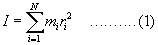
Consider a system consists of N particles.
Suppose the mass of the ith particle is mi and
at a distance of ri from the rotating axis. The moment
of inertia of the system is |
0.5 |
|
 |
1 |
|
The factors that affects the value of I
are: |
|
|
-
the mass of the body
-
the way in which the masse is distributed (or shape), and
-
the position of the axis of rotation
|
1.5 |
| |
|
|
| b. |
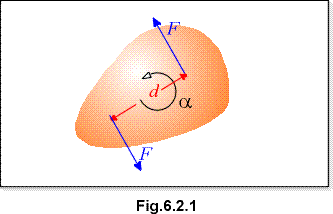
State
the Newton’s Second Law for rotation. Explain how the motion of a rigid
body acted on by two equal but opposite forces depends on the points of
application. |
3
marks |
| |
|
|
|
Newton's Second Law for Rotation |
|
|
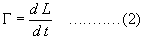
The torque acting on a rotating system is equal to the
time rate of change of angular momentum of that body. |
|
|
Mathematically,
 |
1 |
|
For a rigid body (I does not change), |
|
|
 |
0.5 |
|
 |
0.5 |
|
The separation between the two forces determines the size
of the torque. |
|
|
 |
0.5 |
|
The larger is the separation, the greater is the turning
effect. |
0.5 |
| |
|
|
| c. |
Describe
an experiment to determine the moment of inertia of a flywheel, stating
the measurements needed to be taken and how they can be integrated to give
the final result. |
6
marks |
| |
|
|
|
 |
1 |
|
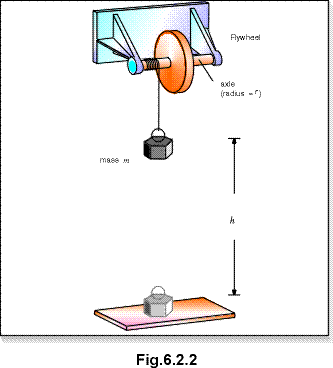
Step 1. Measure the radius, r, of the
axle of the flywheel with a caliper. |
|
|
Step 2. Hang the mass with a string. Wind up
the mass by the axle through height h. |
|
|
Step 3. Put a chalk mark on the flywheel for
counting no. of turns. |
|
|
Step 4. Release the mass and count the no.
of turns N before the ground is reached. |
|
|
Step 5. Further count the no. of turns N'
after the mass hits the ground.
Measure this time interval t by a stop watch. |
2 |
|
As m falls, its gravitational p.e. is
converted into translational k.e., rotational k.e. and work done against
friction. |
|
|
Let the energy loss per turn be Ef. |
|
|
 |
1 |
|
After hitting the ground, the k.e. of the flywheel
is dissipated in N' turns: |
|
|
 |
1 |
|
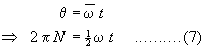
As it performs N' turns in time t,
we have |
|
|
 |
1 |
|
Combining (5), (6) and (7), it is possible
to find the moment of inertia I of the flywheel. |
|
| |
|
|
| d. |
Make
an analogy between rotational motion and rectilinear motion in terms of
i)
inertia |
4
marks |
| |
|
|
|
mass vs moment of inertia |
1 |
|
|
|
|
ii)
Newton’s Second Law |
|
| |
|
|
|
Rectilinear |
|
|
The rate of change of momentum of a mass is in the same direction
and directly proportional to the net force.
For a constant mass,

|
|
|
Rotational |
|
|
The torque is equal to the rate of change of angular momentum
of a rigid body.
For a rigid body,

|
|
|
|
|
|
iii)
conservation law of momentum, and |
|
| |
|
|
|
Rectilinear |
|
|
The linear momentum of a system is conserved if there is no
external force acting on the system.
For two masses involved in a collision,

|
|
|
Rotational |
|
|
The angular momentum of a system is conserved if there is no
external torque acting on the system.
For a rotating body whose shape changes,

|
|
|
|
|
|
iv)
kinetic energy |
|
| |
|
|
| |
Rectilinear |
|
|
The kinetic energy of a mass m moving with speed v
is

|
|
|
Rotational |
|
|
The rotational kinetic energy of a system with moment of inertia
I rotating at angular speed w about an
axis is

|
|
|
|
|