| a. |
Explain
the meaning of the inertia of an object in rectilinear motion. Show that
an analogy exists in rotational motion. |
3
marks |
| |
|
|
|
In rectilinear motion, inertia is a property
of matter that causes it to resist any change in its motion. |
0.5 |
|
Mass of a body is a quantitative measure of
its inertia. |
0.5 |
|
In rotational motion, moment of inertia measures
the resistance of a rigid body to any change in rotational motion. |
1 |
|
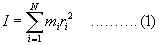
The moment of inertia of a body about a certain
rotational axis is defined as |
|
|
 |
|
|
where mi is the mass of the
ith particle and ri is its distance from the rotational
axis. |
1 |
| |
|
|
| b. |
A
rigid body rotates about an axis with an angular speed w. By considering
that the rigid body is made up of many small particles, find an expression
for its kinetic energy. |
3
marks |
| |
|
|
|
 |
1 |
|
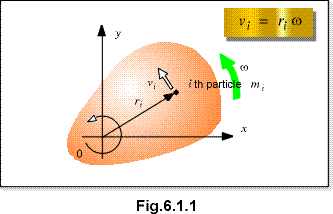
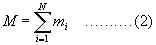
Consider a rigid body of total mass M rotating at
a angular speed w about a fixed axis. The rigid
body can be treated as a composition of N particles, such that |
|
|
 |
|
|
The kinetic energy of the ith particle of mass mi
and at a distance of ri from the axis is |
|
|
 |
1 |
|
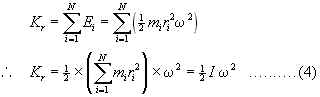
The total kinetic energy of the body is |
|
|
 |
1 |
| |
|
|
| c. |
Devise
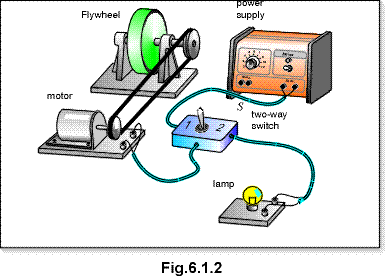
an experiment to show that a rotating flywheel carries energy. |
4
marks |
| |
|
|
|
 |
1 |
|
The two-way switch S is used to connect the
motor to either the power supply or the lamp. . |
1 |
|
When S is connected to the power supply, the
flywheel speeds up and is charged to store rotational kinetic energy |
1 |
|
When S is connected to the lamp, the power
supply is cut off. However, the lamp lights up. This is because the flywheel
delivers its energy to keep the motor rotating. |
1 |
| |
|
|
| d. |
Explain
the role played by a flywheel in energy transmission of a car. |
2
marks |
| |
|
|
|
The engine of a car produces highly uneven
power, because explosions occurs in successive interval of time. |
0.5 |
|
A flywheel could store up the large burst of
energy in the form of rotational kinetic energy and then delivers the energy
to the car between two bursts. |
1 |
|
This produces a more uniform supply of energy. |
0.5 |
| |
|
|
| e. |
A car
is accelerating on a rough horizontal road. By referring to the energy
change and the accelerating motion of the car, discuss the frictional force
acting on the wheel between
i)
the wheel and the road surface, |
4
marks |
| |
|
|
|
As the wheel exerts a backward force on the
road surface, by Newton's 3rd Law, the road exerts a forward force on the
wheel. The force is known to be a friction. |
0.5 |
|
In normal acceleration, there is no relative
motion between the tyre and the road at the point of contact. Thus, the
work done against by this force is zero (because displacement is zero).
Thus, the force is a static friction. |
1 |
| |
|
|
|
ii)
the crankshaft and the chassis. |
|
| |
|
|
|
The crankshaft and the chassis are in constant
relative motion. The rotating crankshaft rubs against the relatively fixed
chassis. This is the one of the causes of energy loss in cars (The other
cause is due to air resistance). |
1 |
|
The force involved is a kinetic friction. |
1 |
|
|
|