Chapter 5   Question 5
 
a. What is a damped oscillation? Account briefly for the difference between critical damping and heavy damping. Give two examples of critical damping. In each case, explain why critical damping is necessary and how damping is introduced.  8 marks
 
A damped oscillation is an oscillation with energy loss so that the amplitude decreases with time. 1
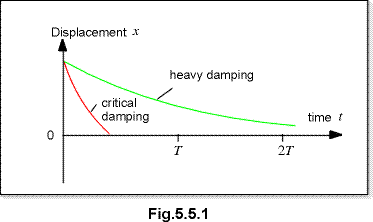
In a critical damping, the system returns to the rest at the equilibrium position in the shortest possible time. There is no oscillation at all. 1
Heavy damping is similar to critical damping, except that the system returns to rest more slowly because of greater resistive force. 1
c0505a.gif (4561 bytes) 1
Examples of critical damping:
  1. Car shock-absorber is used to damp the vertical oscillation when a car moves over humps and bumps on the road. A piston moves inside a cylinder of oil. The thickness of oil is chosen so that the chassis returns to its resting position in the shortest time.
  2. The oscillation of the coil of a galvanometer should be damped critically, otherwise, it would waste much time in waiting for the pointer to come to rest. Damping is done by wrapping the coil on an aluminum frame. The eddy current flows in the frame resisting the oscillation.


2
 
b. Identify the driving force and driven motion in the hacksaw blade oscillator. Briefly account for the cause of resonance in the hacksaw blade, explaining how the dependence of amplitude at resonance on damping could be investigated. 4 marks
 
c0505b.gif (9381 bytes) 1
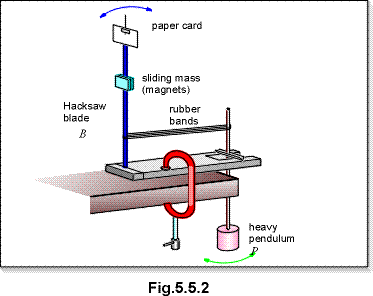
The driving force comes from the heavy pendulum. The hacksaw blade is the driven system. 1
The natural frequency of the hacksaw blade can be adjusted by sliding the magnets up and down along its length. Resonance occurs when the natural frequency and the frequency of the heavy pendulum are equal. This results in a very large amplitude. 1
The damping of the hacksaw blade can be varied by turning the paper card so as to vary the air resistance of the driven system. 1
 
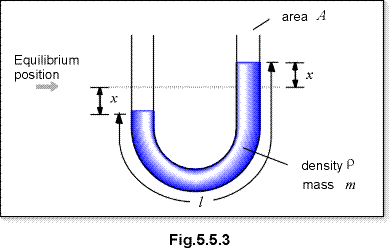
c. Show that the motion of liquid in a U-tube is simple harmonic. Discuss how the period of motion depends on the amount of liquid and the width of the tube. 4 marks
 
c0505c.gif (7686 bytes) 1
Suppose the liquid in the tube is displaced by x.
The net force acting on the liquid (due to the weight difference on the limbs) is
 wpe1E.jpg (1687 bytes) 0.5
The acceleration of the liquid is given by
 wpe1F.jpg (2349 bytes) 
 wpe20.jpg (3524 bytes)
1
So, the motion is harmonic. The period of oscillation is
 wpe21.jpg (2251 bytes) 0.5
The period is independent of the type of liquid or the width of the tube. It depends on the length of the liquid only. 1
 
Hosted by www.Geocities.ws

1