| a. |
What
is an isochronous oscillation? Give an example. |
2
marks |
| |
|
|
|
In an isochronous oscillation, the frequency
is independent of the amplitude of oscillation. |
1 |
|
All simple harmonic motions are isochronous.
e.g. simple pendulum. |
1 |
| |
|
|
| b. |
State
Archimedes’ principle. Explain how the weight of a floating object is related
to the upthrust from the liquid. Hence, show that after a floating cylinder
is pressed down briefly and then released, it will perform vertical simple
harmonic motion. Discuss how the period of oscillation is related to the
shape of the floating object. |
5
marks |
|
|
|
|
Archimedes' principle |
|
|
When an object is wholly or partially immersed in a fluid,
the upthrust on the object is equal to the weight of the fluid displaced. |
1 |
|
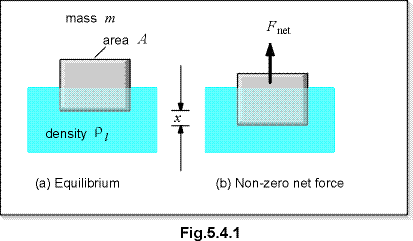
For a floating object, the upthrust is equal to the weight
of object. |
1 |
|
 |
|
|
Suppose the volume of the floating object immersed in water
at equilibrium is V. |
|
|
 |
1 |
|
where rl is
the density of the liquid and m is the mass of the object. |
|
|
If the object is displaced by x downward, the upthrust
becomes |
|
|
 |
|
|
The net force acting on the object is |
|
|
 |
|
|
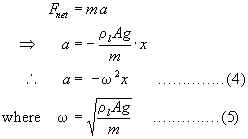
Thus, the acceleration is given by |
|
|
 |
1 |
|
Thus, the motion is simple harmonic. |
|
|
Suppose the object is a cylinder with cross-sectional area
A and height h. |
|
|
 |
|
|
The period of oscillation is |
|
|
 |
|
|
It is independent of the cross-sectional area and is longer
for a shorter cylinder. |
1 |
| |
|
|
| c. |
What
is a forced oscillation? Discuss how the amplitude and frequency of the
driven system vary with the frequency of the driving force. |
3
marks |
| |
|
|
|
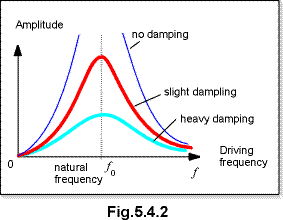
A forced oscillation is motion produced when
a vibrating system is acted upon by an external periodic force. |
1 |
|
Without the external force, the system vibrates
freely at its natural frequency. |
|
|
When the driving frequency is close to the
natural frequency, the amplitude is very large. In particular, when the
two frequencies are equal, resonance occurs. |
1 |
|
 |
1 |
| |
|
|
| d. |
Using
a table, show the phase relationship between the driven system and the
driving force in a forced oscillation. Describe an experiment to show the
phase relationship in such an oscillation. |
5
marks |
| |
|
|
|
When the driving frequency f is less
than the natural frequency fo (f < fo),
the phase difference f is zero. |
|
|
When f = fo, f
= p/2. |
|
|
When f > fo, f
= p. |
|
|
| Driving frequency |
Driven system lags behind the driving force
by f |
| less than fo |
0 |
| equal to fo |
p/2 |
| larger than fo |
p |
|
2 |
|
Barton's pendulum |
|
|
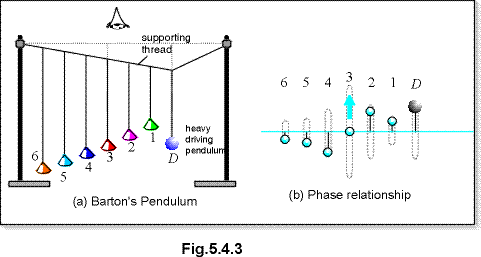
It consists of a horizontal thread which supports
a massive pendulum D and a number of paper cone pendulums, one of which
has the same length as D. |
1 |
|
When D is pulled aside and then released, all
other pendulums are forced to oscillate. The phase relationship can be
observed from above. |
1 |
|
 |
1 |
| |
|
|
| e. |
Give
an example of resonance. |
1
mark |
| |
|
|
|
-
Falling of the Tacoma Narrows Bridge
-
Absorption spectrum
-
musical instrument
-
tuning circuit
|
1 |
|
|
|