| a. |
A
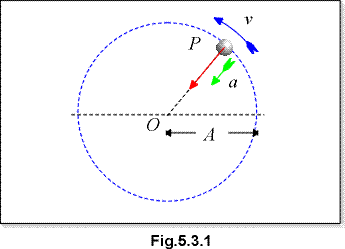
particle P moves at a constant angular speed w in a circular path of radius
A centered at the origin O. Sketch to show the net force on P, putting
down its linear speed and acceleration. No mathematical proofs are required. |
2
marks |
| |
|
|
|
 |
1 |
|
The speed of P is
 |
0.5 |
|
The acceleration of P is the centripetal
acceleration for it to move in a circular path. a points towards O
and is |
|
|
 |
0.5 |
| |
|
|
| b. |
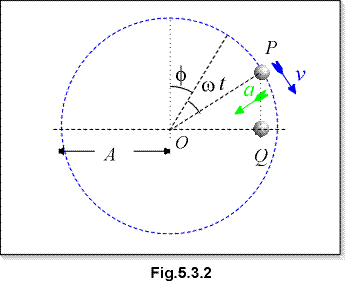
At
time t = 0, the line joining P and the origin makes an angle f with the
y-axis. Q is the projection of P on the x-axis. Sketch a new diagram to
show the positions of P and Q after time t. Write down the mathematical
expressions for the displacement, velocity and acceleration of Q. Hence,
show that the motion of Q is simple harmonic. |
6
marks |
| |
|
|
|
 |
2 |
|
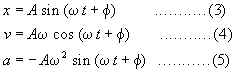
The equations for displacement, velocity and acceleration
are |
|
|
 |
3 |
|
From (3) and (5), |
|
|
 |
|
|
Thus, the motion of Q is simple harmonic. |
1 |
| |
|
|
| c. |
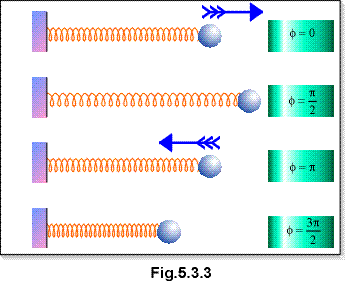
If
Q represents the location of a mass attached to a horizontal spring. Discuss
how the motion of the mass is started if
i)
f = 0,
ii)
f = p/2,
iii)
f = p,
iv)
f = 3p/2. |
4
marks |
| |
|
|
|
 |
2 |
|
i) For f
= 0, the particle is projected from the equilibrium position to the increasing
direction of x. |
0.5 |
|
ii) For f
= p/2, the particle is pulled to the right and
then released. |
0.5 |
|
iii) For f
= p, the particle is projected from the equilibrium
position to the decreasing direction of x. |
0.5 |
|
iv) For f
= 3p/2, the particle is pulled to the left and
then released. |
0.5 |
| |
|
|
| d. |
Discuss
how the energy of Q varies with
i)
the stiffness of the spring used, |
4
marks |
| |
|
|
|
The energy of Q includes both kinetic energy
and potential energy. However, it is a constant which is equal to the maximum
of k.e. or maximum p.e. |
|
|
 |
1 |
|
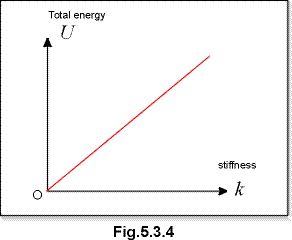
Stiffness of the spring is proportional to
k.
Thus, energy of Q is proportional to stiffness of the spring: |
0.5 |
|
 |
1 |
|
 |
0.5 |
| |
|
|
|
ii)
the amplitude of oscillation.
Use appropriate graphs to illustrate your answer. |
|
| |
|
|
|
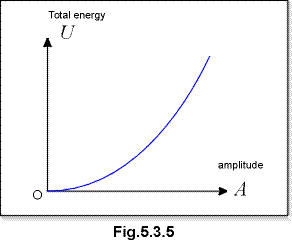
The energy of Q is proportional to the square
of the amplitude: |
0.5 |
|
 |
0.5 |